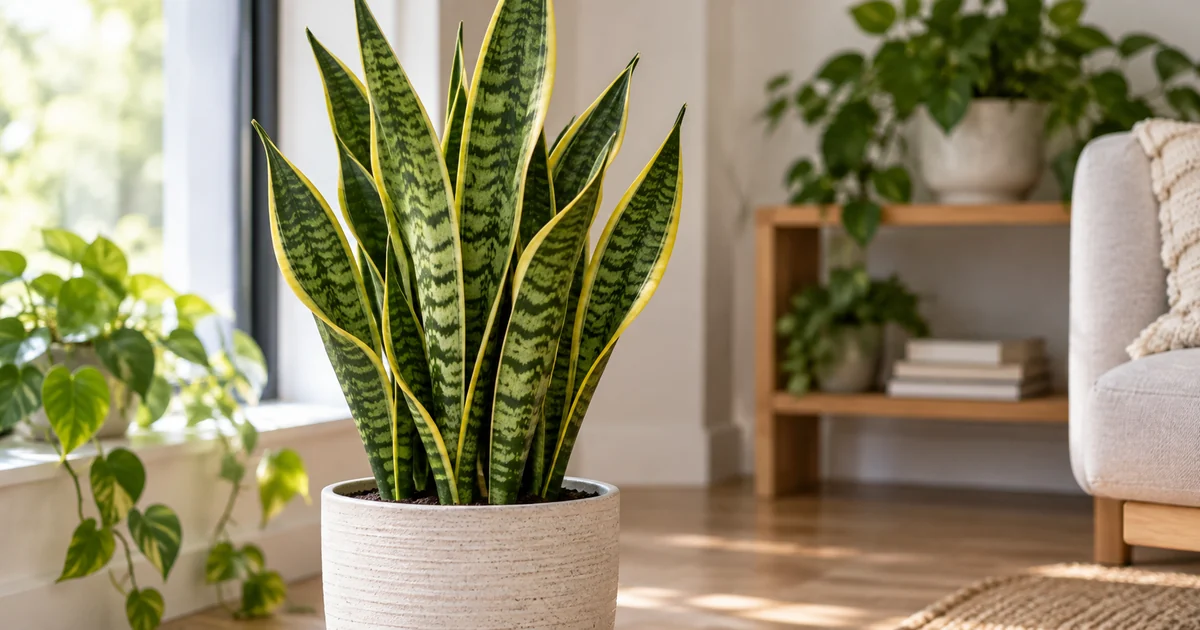
Snake plants grow as clumps of upright, water-storing leaves connected below the potting mix by rhizomes. That structure explains much of their care: they tolerate the root zone drying, expand sideways by producing new shoots, and are more vulnerable to prolonged wetness than to a missed watering. Good care is less about following a calendar and more about matching water, light, and potting conditions to the plant’s slow-changing root zone.
Know the Plant You Are Growing
The accepted name for the familiar snake plant is Dracaena trifasciata; it was long sold as Sansevieria trifasciata, and both names still appear on labels and care references. Cultivars vary from tall, sword-leaved forms to compact bird’s-nest types. Variegated plants may grow more slowly than solid-green forms because they have less chlorophyll-bearing tissue.
New leaves do not unfurl from the tip of an old leaf. They emerge as separate shoots from underground rhizomes. A plant that leans toward the window or sends a new shoot against the pot wall is responding through its clumping growth habit, not necessarily signaling disease.
Light: Tolerance Is Not the Same as Preference
Snake plants can persist in low light, but tolerance should not be confused with ideal growth. In brighter filtered light, they generally produce new shoots more readily and maintain stronger, more compact foliage. In a dim location, water use and growth slow, so the root zone stays wet longer.
Place the plant where it receives bright filtered light or gentle direct sun. A plant accustomed to a dim room can scorch if moved immediately into intense window or outdoor sun. Increase exposure gradually over a week or more, watching the window-facing leaves for pale, bleached, or sharply browned patches.
Rotate the pot occasionally if growth leans toward one side, but do not repeatedly relocate a stable plant. For a fuller explanation of indoor intensity and distance from windows, see what low light means for plants.
Water the Root Zone, Not the Calendar
Allow the potting mix to dry through most or all of the root zone before watering again. Confirm conditions below the surface with the pot’s weight, a wooden skewer, or a moisture check at several depths. The top inch can be dry while the lower mix remains wet.
When watering is needed, wet the mix evenly and let excess leave through the drainage hole. Empty any cachepot or saucer. Do not add small sips on a fixed schedule; they can leave part of the root ball dry while another part remains chronically damp.
The interval changes with light, temperature, pot size, medium, root mass, and season. A plant in brighter summer conditions may dry much faster than the same plant in a cool, dim winter room. Our specialist guide explains how often to water a snake plant without turning those variables into a universal number.
Wrinkling can indicate that leaves are using stored water, but it can also occur when damaged roots cannot supply water. Check the root zone before assuming a thirsty-looking plant needs more.
Build a Fast-Draining Root Environment
A suitable mix should accept water, drain freely, and retain enough air as it dries. A commercial cactus or succulent mix can work, but products vary. If a mix remains dense and wet for many days, amend it with a stable, coarse drainage material appropriate for container plants rather than relying on a “succulent” label alone.
Use a container with an unobstructed drainage hole. Terracotta can help a mix dry faster, but it is not automatically better: in a hot, bright location it may dry too rapidly, while a glazed or plastic pot may be easier to manage. Choose the pot and mix as one system.
Do not put stones in the bottom as a substitute for drainage. Water still needs a route out of the container. A pot only slightly larger than the root and rhizome mass is usually easier to water predictably than a greatly oversized pot.
Rhizomes, Crowding, and Repotting
Snake plants often tolerate a snug container, but “likes to be root-bound” should not become a reason to ignore a distorted or unstable pot. Repot when rhizomes crowd the rim, the container cracks or tips, roots block drainage, the medium has collapsed, or water no longer moves through the root ball normally.
Move up by one practical pot size rather than surrounding a small root mass with a large volume of wet mix. Spring through active growth is convenient, but an urgent drainage or root problem should be handled when found. See when to plant or repot a snake plant for timing and division steps.
If the plant is healthy, division at a natural rhizome junction is the most reliable way to preserve variegation. Leaf sections can also root, but some variegated cultivars may produce green offspring from leaf cuttings. Keep the bottom orientation of each section correct when propagating in mix.
Temperature, Season, and Feeding
Normal indoor temperatures suit snake plants, but protect them from freezing, cold glass, and persistent cold drafts. Chilling injury can appear as soft, water-soaked, or collapsing tissue and may not be obvious immediately after exposure.
Growth often slows when days shorten, light decreases, or rooms become cooler. During that period, the plant uses water and nutrients more slowly. Let actual drying and new growth guide care rather than automatically following a summer routine.
Fertilize conservatively only when the plant is actively growing and its roots are healthy. Check whether the potting mix already contains fertilizer, then use a product labeled for houseplants at its directed rate. Repeated feeding is not a remedy for slow growth in low light, and excess soluble salts can injure roots or contribute to leaf-edge damage.
Snake Plant Symptom Router
One symptom can have several causes. Use this table to decide what evidence to check and when a specialist guide is more useful than another general-care list.
| What you see | Check first | Possibilities to compare | Relevant Plantiva guide |
|---|---|---|---|
| Yellow leaves | Root-zone moisture, leaf age, and recent temperature changes | Persistent wetness, natural aging, root stress, cold injury, pests | Snake plant watering |
| Soft or mushy base | Tissue texture, drainage, roots, and rhizomes | Cold injury, prolonged wetness, physical damage, root or rhizome deterioration | Rotting snake plant leaves |
| Wrinkled or folding leaves | Moisture through the root ball and root condition | Extended dryness, roots unable to take up water, heat stress | Snake plant watering |
| Brown tips | Watering history, salt buildup, heat, and physical injury | Irregular moisture, excess fertilizer, mineral salts, damaged tips, hot or cold exposure | Diagnose plant problems |
| Leaf collapse or leaning | Base firmness, light direction, and root support | Mechanical damage, weak low-light growth, deteriorating base, an old heavy leaf | Rotting snake plant leaves |
| Spreading spots | Whether lesions expand and whether leaves stay wet | Physical injury, chilling, sun scorch, fungal or bacterial disease | Snake plant fungus guide |
| Webbing, cottony material, bumps, or insects | Leaf bases, both surfaces, and nearby plants | Spider mites, mealybugs, scale, thrips, or another pest | Snake plant bug guide |
| Very slow growth | Season, light, temperature, roots, and cultivar | Normal winter slowdown, dim light, tight or damaged roots, nutrient limitation | Low-light guide |
Wet mix alone does not confirm root rot, and dark root color alone is not enough. Healthy root appearance varies with age and medium. Root or rhizome deterioration is more strongly indicated by tissue that is soft, mushy, collapsing, sloughing, or easily breaking alongside continued decline.
Flowers and Other Unusual Growth
A mature snake plant may occasionally produce a stalk of small pale flowers. Blooming is not proof that the plant is dangerously stressed, nor is it a signal to change every part of its care. Keep conditions stable, inspect normally, and remove the stalk after flowering if desired. The specialist article explains why snake plants flower and what to do next.
Questions about deliberately changing acidity also need restraint. Test before adjusting a mix, because drainage and root health usually matter more than chasing a precise pH number. See snake plant soil and pH guidance.
Pet Safety
The ASPCA lists snake plant as toxic to cats and dogs because it contains saponins. Reported signs include nausea, vomiting, and diarrhea. Keep the plant out of reach of animals that chew foliage. If ingestion is suspected or a pet is unwell, contact a veterinarian or animal poison-control service rather than attempting a home treatment.
A Practical Care Check
Before watering or feeding, check four things: the depth of remaining moisture, the firmness of the leaf bases, the amount of usable light, and whether the pot can drain. Those observations explain more than a date on a calendar. Preserve stable conditions when the plant is healthy; when it is not, use the symptom pattern and specialist guides to investigate one likely cause at a time.
Sources
- North Carolina Extension Gardener Plant Toolbox — Dracaena trifasciata
- RHS — Dracaena trifasciata Plant Profile
- Iowa State University Extension — Propagating Houseplants
- ASPCA — Snake Plant Toxicity