A yellow leaf, wilted stem, or brown edge describes what a plant is doing; it does not identify why. Accurate diagnosis comes from combining the plant’s identity, symptom pattern, root-zone condition, environment, visible evidence, and recent history. Work from observation to likely cause, then change one non-urgent factor at a time so the plant’s response remains meaningful.
Symptoms, Signs, and Evidence
A symptom is the plant’s response to stress or injury: yellowing, wilting, curling, spots, leaf drop, or slowed growth. Different causes can produce the same symptom. Wilting, for example, may follow a dry root zone, damaged roots in persistently wet mix, heat, or disease.
A sign is direct evidence of a causal organism or problem, such as visible insects, mite webbing, fungal growth, sticky honeydew, standing water, or clearly deteriorating tissue. Signs usually narrow the possibilities more than symptoms do, but they still need context. Webbing plus moving mites is more useful evidence than leaf speckling alone.
| Observation type | Examples | What it can establish |
|---|---|---|
| Symptom | Yellow leaves, drooping, brown margins, curling | The plant is responding to something; it rarely identifies one cause by itself |
| Sign or direct evidence | Insects, webbing, honeydew, fungal structures, standing water | A specific factor is present, though it may not be the only problem |
| Context | Plant identity, moisture, light, timing, care history | Whether a suspected cause fits the plant and situation |
1. Identify the Plant and Its Normal Appearance
Start with the correct species or cultivar. A variegated leaf, seasonal leaf loss, naturally arching habit, colored stem, or dormant period may be normal for one plant and concerning in another. Compare the plant with reliable species-specific information, not with a generic idea of a “healthy plant.”
Record its location, pot and drainage setup, potting medium, and basic care. If you cannot identify it confidently, photograph the whole plant, leaf arrangement, stems, and any flowers before trying a treatment.
2. Define the Symptom Precisely
Replace a broad description such as “the plant looks bad” with observable details:
- Which plant part changed: leaf, stem, crown, root, flower, or fruit?
- Is the tissue yellow, pale, brown, black, translucent, dry, soft, sunken, spotted, or distorted?
- Are margins, tips, veins, spaces between veins, or entire leaves affected?
- Is the plant wilted while the root zone is dry, moist, or persistently wet?
- Are there insects, shed skins, webbing, sticky residue, odor, or deteriorating tissue?
Take dated photographs in consistent light. They make gradual spread, recovery, or stability easier to judge than memory does.
3. Map Where the Problem Appears
Pattern is often more informative than color. Check the entire plant and nearby plants.
- Old leaves or new growth: Some nutrient and root problems appear first on older leaves; others affect new tissue. This distinction narrows possibilities but does not confirm a deficiency.
- One leaf or the whole plant: A single damaged leaf may reflect age or physical injury. Widespread change suggests a plant-wide root, water, light, temperature, or nutrient issue.
- One side or one height: Damage facing a sunny window, heater, cold pane, or draft points toward a localized environmental cause.
- Localized or spreading: A stable patch can follow scorch or mechanical injury. Expanding lesions or symptoms moving from plant to plant deserve closer pest or disease investigation.
- One species or several: The same sudden symptom across unrelated plants can point to a shared environmental event, irrigation issue, or chemical exposure.
Do not remove every affected leaf immediately. Keeping one representative leaf can help you compare progression, unless the tissue is badly decayed or a confirmed pest or disease requires sanitation.
4. Check Root-Zone Moisture Before Watering
Judge moisture below the surface and across the root zone. A dry-looking top layer can sit above wet mix, while peat-based mix can shrink from the pot and resist absorbing water even when water runs down the sides.
Check the pot’s weight, feel the medium at more than one depth where practical, and confirm whether excess water can leave the container. Review when and how much water was applied. Our houseplant watering guide explains why calendar watering is less reliable than checking the plant and root zone.
Keep the terms separate:
- Overwatering is a watering behavior: applying water too frequently or in a way that keeps the root zone wet for too long.
- Persistent wetness is the growing condition that can limit oxygen and stress roots. It may result from watering, poor drainage, an oversized pot, compacted mix, cool conditions, or low plant water use.
- Root rot should describe confirmed root deterioration or disease, not yellow leaves or wet mix alone.
5. Check Soil and Drainage
Inspect the container before disturbing roots. Is there a drainage opening? Is a cachepot holding water? Has the medium collapsed or become compacted? Does water leave evenly, run straight down a gap at the pot edge, or remain on the surface?
Remove the root ball only when the evidence justifies it—for example, persistent wilting in wet mix, a soft crown or stem base, a sour or decaying odor, unexplained decline after drainage failure, or suspected severe root restriction. Repeatedly unpotting a stable plant can create new damage.
Healthy root color varies by species and medium. Dark color alone does not prove rot. Look for structure and texture: viable roots generally hold together and feel firm, while concerning roots may be soft, mushy, collapsing, sloughing, or easily breaking alongside continuing decline. If deterioration is present, correct the water and drainage conditions and investigate whether a pathogen or other injury is involved rather than labeling every wet root “root rot.”
6. Review Light, Temperature, and Air Conditions
Compare the location with the identified plant’s needs. “Bright,” “indirect,” and “low light” are relative terms; window direction, distance, obstructions, season, and day length all change the amount a plant receives. Use our guide to what low light means for plants when the location is uncertain.
Look for patterns that fit the environment:
- Pale, elongated, or weak new growth can be consistent with insufficient light.
- Bleached or sharply browned patches on the window-facing side can follow a rapid increase in sun or heat.
- Sudden leaf drop may follow a move, cold draft, hot vent, temperature swing, or abrupt change in light.
- Brown tips can occur with dry air, uneven moisture, excess soluble salts, root stress, or physical injury; humidity is only one possibility.
Measure or observe conditions where the plant actually sits. A thermostat across the room does not reveal a cold window surface or a stream of hot air from a vent.
7. Inspect for Pests and Visible Disease Evidence
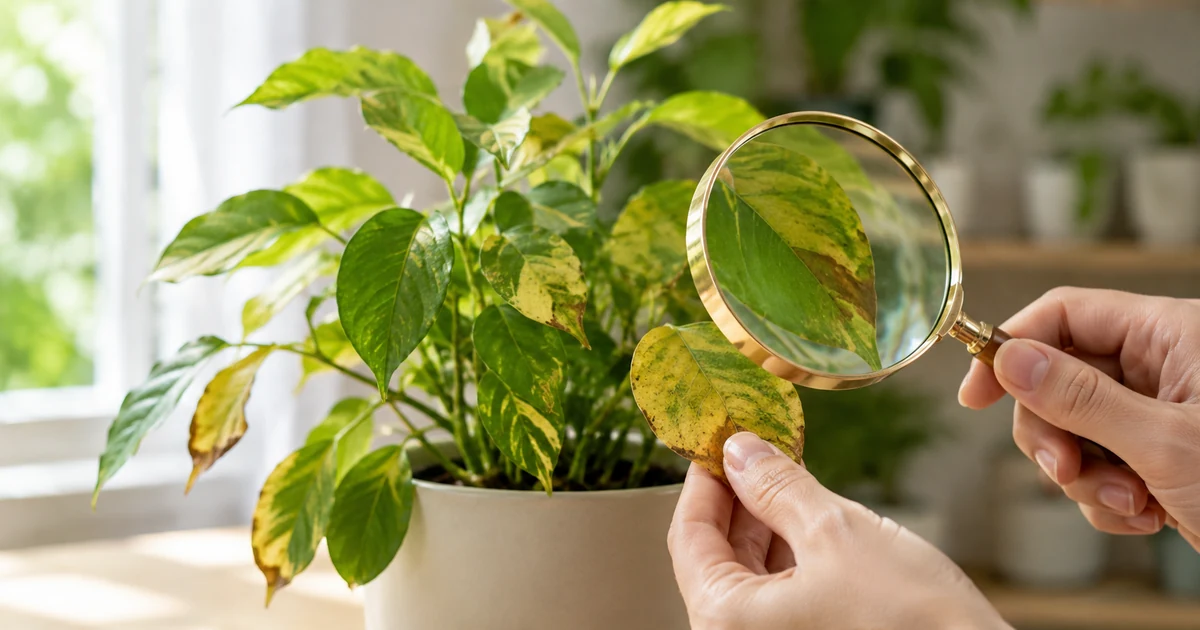
Use bright light and, if possible, a hand lens. Check leaf undersides, veins, nodes, new growth, stem bases, and the surface of the medium. Turn the plant rather than looking only at the front.
Useful evidence includes moving insects or mites, cast skins, fine webbing, cottony clusters, immobile scale covers, sticky honeydew, black sooty growth on sticky leaves, or characteristic feeding marks. Our guide to houseplant bugs helps match evidence to common indoor pests.
If you confirm a pest, isolate the plant from nearby plants and identify the pest before choosing a control. A product must be labeled for the pest, plant, and indoor or outdoor setting where it will be used. Do not combine homemade sprays or pesticides simply because the exact cause remains uncertain.
Leaf spots are not automatically infectious disease. Physical injury, chilling, excess sun, chemical spray, and watering problems can create spot-like damage. Note whether lesions are expanding and whether similar symptoms are spreading. A local extension service or diagnostic clinic can confirm problems that cannot be distinguished visually.
8. Reconstruct the Timeline
Ask what changed before the first symptom appeared:
- Was the plant moved, repotted, divided, propagated, or brought indoors?
- Did light, temperature, humidity, or day length change?
- Was there a missed watering, repeated watering, drainage failure, or standing water?
- Was fertilizer, pesticide, leaf cleaner, or another product applied? At what concentration?
- Did a new plant join the collection?
- Did the problem appear suddenly, gradually, or after a delay?
Timing can rule possibilities in or out. Scorch soon after a move into direct sun fits the history better than a deficiency that supposedly appeared overnight. A decline that began before repotting was not caused by the repotting itself, though root disturbance may complicate recovery.
9. Use the Pattern to Rank Likely Causes
The table below is a triage tool, not a list of automatic diagnoses. Start with the first check, compare it with the plant’s history, and keep more than one plausible cause until evidence separates them.
| What you observe | Check first | Possible causes to compare | Practical next step |
|---|---|---|---|
| Yellow leaves | Root-zone moisture, leaf age, and recent changes | Natural aging, persistent wetness, drought, low light, root stress, pests, nutrient shortage or excess | Map old versus new leaves; correct a confirmed environmental problem before feeding |
| Drooping or wilting | Whether the root zone is dry, evenly moist, or persistently wet | Water deficit, heat, damaged roots, poor drainage, disease | Do not water automatically; use moisture and root evidence to choose the response |
| Brown tips or edges | Watering pattern, salt history, heat, drafts, and humidity | Uneven moisture, fertilizer or water salts, root stress, dry air, scorch, physical damage | Review applications and conditions; trim only for appearance after the cause is addressed |
| Curling or distorted leaves | New growth, pests, temperature, and recent sprays | Mites or insects, heat, cold, chemical injury, water stress | Inspect with magnification and review what contacted the foliage |
| Sudden leaf drop | Recent move, temperature event, and moisture | Environmental shock, cold or heat, drought, persistent wetness, root damage | Stabilize conditions and monitor instead of changing several factors at once |
| Soft stem or crown | Root-zone wetness and tissue integrity | Persistent wetness, freeze or chilling injury, bacterial or fungal decay | Isolate if disease is possible; inspect affected tissue and roots promptly |
| Fine webbing and speckling | Leaf undersides with a hand lens | Spider mites or spiders; mites are more likely when moving dots and feeding damage occur | Confirm the organism, isolate the plant, and use a labeled management method |
| Sticky leaves | Leaf undersides, stems, and foliage above the residue | Honeydew from scale, aphids, mealybugs, or whiteflies; spilled products | Find and identify the source before cleaning or treating |
| Slow or weak growth | Species, season, light, roots, pot space, and nutrition history | Normal slow season, insufficient light, root restriction or damage, nutrient issue, pest pressure | Compare with normal growth and correct the strongest supported limitation |
| Bleached or scorched patches | Orientation to window or lamp and timing | Sudden sun exposure, heat, chilling, chemical spray, physical injury | Prevent further exposure; damaged tissue will not turn green again |
10. Test the Best Explanation, Then Monitor
Rank causes by asking three questions: Does this cause produce the observed pattern? Does it fit the timing and care history? Is there direct evidence? Give more weight to an explanation supported by all three than to a familiar diagnosis based on one symptom.
For a stable plant, change the most likely non-urgent factor first and record what you did. Then watch new growth and symptom progression over an appropriate period. Existing damaged tissue often remains damaged, so success may mean the problem stops spreading rather than old leaves becoming perfect.
Avoid simultaneously changing watering, light, location, potting mix, and fertilizer. Multiple changes create new stress and make it impossible to learn which action helped. Diagnose first, treat second, and monitor before changing several variables at once.
Urgent evidence can justify more than one immediate action. Standing water, rapidly collapsing tissue, a heavy pest infestation, or a hazard to nearby plants may require isolation plus correction of the underlying condition. Urgency still does not remove the need to identify the problem.
What Not to Do
- Do not diagnose nitrogen deficiency from yellow leaves alone or fertilize a severely stressed plant by default.
- Do not call wet soil “root rot” without examining root structure, texture, and the plant’s decline.
- Do not water a wilted plant until you know whether its root zone is dry or persistently wet.
- Do not move a low-light plant into harsh direct sun in one step.
- Do not apply a pesticide before confirming a pest and reading the label.
- Do not repot repeatedly just to inspect roots when the plant is otherwise stable.
- Do not expect damaged leaves to repair themselves; judge recovery by stability and healthy new growth.
When to Ask for Diagnostic Help
Seek help when symptoms spread despite a well-supported correction, when valuable plants show rapid decline, when a disease or regulated pest is possible, or when pesticide use would require an uncertain identification. A local cooperative extension office, plant diagnostic clinic, or qualified horticulture professional may request photographs, a care timeline, and a properly collected sample.
Before contacting them, record the plant name, onset date, symptom pattern, watering and fertilizer history, recent moves or treatments, and conditions around the plant. Good evidence makes remote diagnosis more useful and reduces guesswork.
A Repeatable Plant-Problem Workflow
Identify the plant, describe the symptom, map the pattern, check the root zone and environment, inspect for direct evidence, reconstruct the timeline, and rank the explanations. Act on the best-supported cause, document the change, and monitor. That process is slower than guessing from leaf color, but it is far more likely to solve the underlying problem without creating a second one.
Sources
- Iowa State University Extension — Diagnosing Houseplant Problems
- Penn State Extension — Diagnosing a Plant Problem 101
- Penn State Extension — Overview of Plant Diagnostics
- UC Statewide IPM Program — Houseplant Problems
- UC Statewide IPM Program — Diagnosing Plant Problems