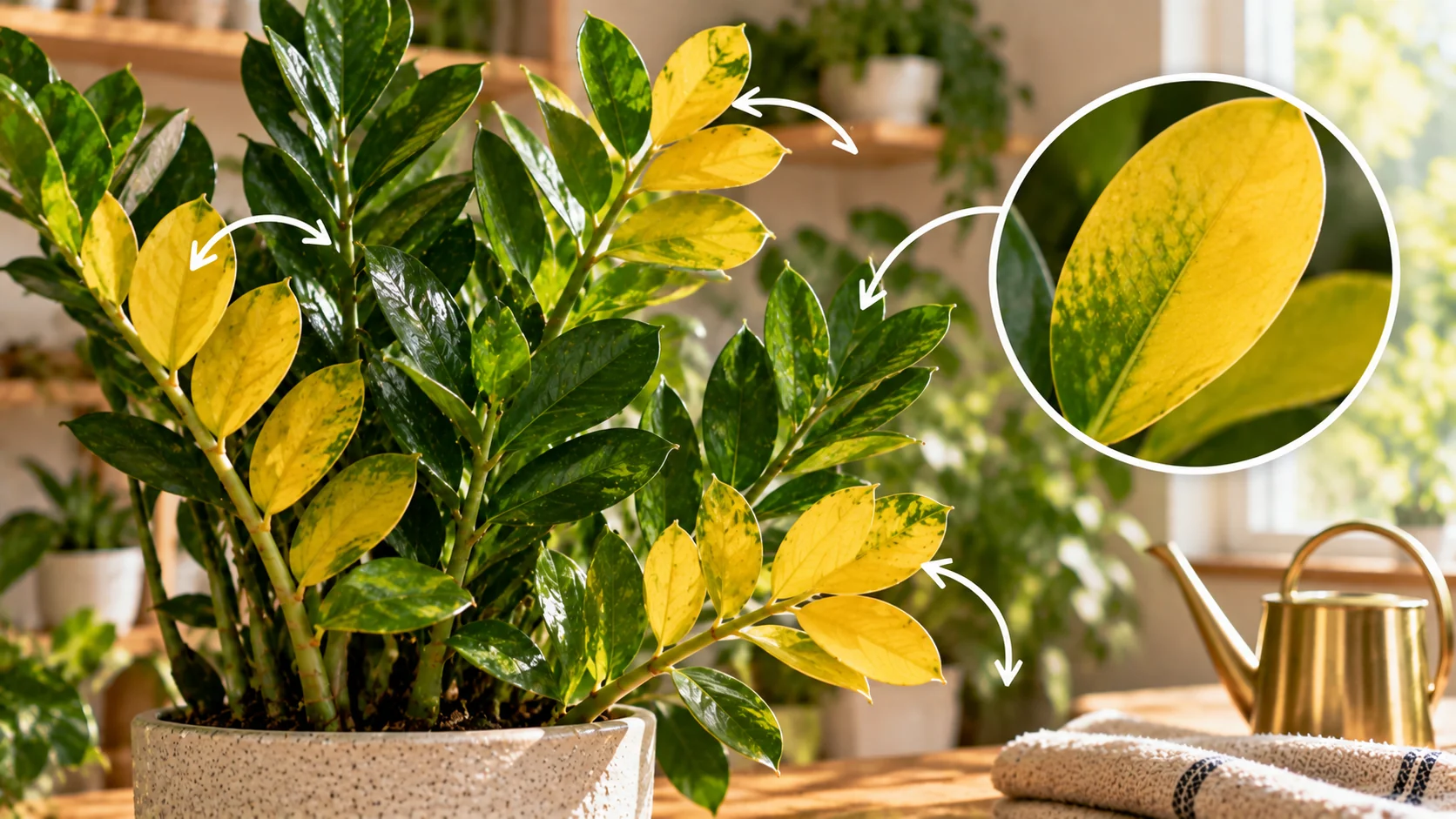
If you're wondering why is my ZZ plant turning yellow, don't panic. ZZ plants are known for being extremely low-maintenance, but yellow foliage is usually a sign that something about the plant's growing conditions needs attention.
The most common cause of ZZ plant yellow leaves is overwatering. ZZ plants have thick underground rhizomes that store water, so they are naturally adapted to periods of dryness. When their potting soil stays wet for too long, the roots and rhizomes can begin to rot, eventually causing the leaves to turn yellow.
However, overwatering isn't the only possibility.
ZZ plant leaves turning yellow can also result from underwatering, poor drainage, low light, excessive direct sunlight, nutrient problems, temperature stress, pests, transplant shock, or the natural aging of older leaves.
The key is to look at where the yellowing appears, how quickly it is spreading, and what the soil feels like.
Why Is My ZZ Plant Turning Yellow?
If several leaves are turning yellow at the same time, check the soil before doing anything else.
A ZZ plant that has yellow leaves and consistently wet soil is much more likely to be suffering from overwatering or root/rhizome problems than from underwatering.
On the other hand, if the pot is extremely light and the soil is completely dry, prolonged underwatering may be responsible.
A single old leaf slowly turning yellow can be completely normal.
The most common causes include:
- Overwatering
- Root or rhizome rot
- Poor drainage
- Underwatering
- Too little light
- Too much direct sunlight
- Natural aging
- Nutrient deficiency
- Temperature stress, pests, or transplant shock
Let's look at how to tell these problems apart.
1. Overwatering Is the Most Common Cause of ZZ Plant Yellow Leaves
If you have ZZ plant yellow leaves, overwatering should be the first thing you investigate.
ZZ plants are drought-tolerant because their underground rhizomes store water. This means they don't need frequent watering like many tropical houseplants.
The problem usually isn't one heavy watering. The problem is watering again before the soil has dried sufficiently.
When the potting mix remains constantly wet, air spaces in the soil become limited. Roots need oxygen to function properly, and prolonged saturation can damage them. Eventually, the plant may respond with yellowing leaves, drooping stems, leaf drop, or root and rhizome rot.
Signs your ZZ plant is overwatered
Look for several symptoms together:
- Multiple leaves turning yellow
- Yellowing starting on lower leaves
- Soil remaining wet for a long time
- A heavy pot several days after watering
- Soft or weak stems
- Leaves dropping
- Slow growth
- A musty or sour smell
- Brown, black, or mushy roots
- Soft underground rhizomes
If the soil is still damp, don't water your ZZ plant just because the leaves are yellow.
More water could make the underlying problem worse.
How to fix an overwatered ZZ plant
Stop watering and allow the potting mix to dry substantially.
Then check:
- Does the pot have drainage holes?
- Is water collecting in the outer container?
- Is the soil dense and compacted?
- Does the pot stay wet for weeks?
- Does the plant have soft stems?
If the plant continues to decline while the soil is wet, inspect the roots and rhizomes.
2. Root Rot or Rhizome Rot Can Cause Yellow Leaves
Overwatering becomes especially serious when it leads to root rot or rhizome rot.
Unlike many houseplants, ZZ plants grow from thick underground rhizomes that act as water-storage organs. When these remain in constantly wet soil, they can become damaged and begin to rot.
This is one reason a ZZ plant can have yellow leaves even though you are giving it plenty of water.
Healthy vs. rotten ZZ rhizomes
Healthy rhizomes are generally:
- Firm
- Plump
- Solid
- Free from unpleasant odors
Rotten rhizomes may be:
- Soft
- Mushy
- Brown or black
- Collapsing
- Foul-smelling
The same applies to the roots.
How to treat ZZ plant root rot
If you strongly suspect rot:
- Remove the plant carefully from its pot.
- Remove excess wet soil around the roots.
- Inspect the roots and rhizomes.
- Cut away severely rotten material with clean tools.
- Repot the healthy portion into fresh, free-draining potting mix.
- Use a container with drainage holes.
- Avoid immediately returning to frequent watering.
Do not simply pour less water into severely waterlogged soil. If the roots or rhizomes are already rotting, the growing medium may need to be replaced.
3. Poor Drainage Can Keep Your ZZ Plant Wet for Too Long
Sometimes the real problem isn't how much you water. It's where the water goes afterward.
A ZZ plant needs a container that allows excess water to escape.
A pot without a drainage hole can trap water around the root system. Even a pot with a drainage hole can cause problems if the soil is extremely dense or if the plant is left sitting in water.
Check your ZZ plant's pot
Make sure:
- The container has drainage holes.
- The holes aren't blocked by roots or compacted soil.
- Excess water can escape freely.
- The plant isn't sitting in a tray of water.
- The pot isn't dramatically oversized for the root system.
After watering, allow excess water to drain away rather than leaving the ZZ plant standing in it.
Poor drainage combined with frequent watering is particularly dangerous for a drought-adapted plant like ZZ.
4. Underwatering Can Also Cause ZZ Plant Leaves to Turn Yellow
Although overwatering is much more common, underwatering is still possible.
A ZZ plant can tolerate dry conditions, but prolonged neglect can eventually cause stress.
If your plant has gone without water for an extended period, the soil may become extremely dry and the pot may feel unusually light.
Signs of underwatering
Look for:
- Bone-dry soil
- A very lightweight pot
- Wrinkled or less firm foliage
- Drooping stems
- Dry or crispy leaflets
- Older leaves yellowing and dropping
- Soil pulling away from the sides of the container
Underwatering is more likely when the soil is genuinely dry rather than damp.
If the soil is completely dry, give the plant a thorough watering and allow excess water to drain completely.
Then return to a less extreme watering routine.
Extension guidance also notes that while both overwatering and underwatering can cause yellowing, underwatering is less likely in ZZ plants because of their drought tolerance.
5. Low Light Can Contribute to Yellowing
ZZ plants are famous for tolerating low light, but low light doesn't mean no light.
A ZZ plant kept in an extremely dark corner may survive, but growth can become very slow and the plant may become less vigorous.
Low light also affects how quickly the plant uses water. If your ZZ is in deep shade and you continue watering frequently, the soil can stay wet for too long.
Signs your ZZ plant needs more light
You may notice:
- Very slow growth
- Long gaps between leaflets
- Weak or stretched stems
- Pale-looking foliage
- Soil staying wet for an unusually long time
Move the plant toward bright, indirect light.
Avoid moving it directly from a dark room into intense afternoon sunlight because the sudden exposure can cause additional stress or leaf scorch.
GrowTropicals notes that ZZ plants can tolerate lower light but still require some natural or artificial light and recommends brighter conditions for healthier growth.
6. Too Much Direct Sunlight Can Scorch ZZ Leaves
ZZ plants don't need strong direct sunlight to thrive.
If your plant sits directly against a hot, sunny window, particularly during intense afternoon sun, its foliage can become scorched.
Sun damage may appear as:
- Yellow patches
- Bleached areas
- Brown crispy sections
- Dry leaf tissue
- Damage concentrated on the window-facing side
This pattern is different from the more uniform yellowing commonly associated with excessive moisture.
How to fix sun damage
Move the ZZ plant farther away from the window or place it somewhere with bright filtered or indirect light.
Don't move it into complete darkness simply because the leaves were exposed to too much sun.
The goal is to find the middle ground: good indirect light without prolonged harsh direct exposure.
7. Natural Aging Can Cause One ZZ Leaf to Turn Yellow
Not every yellow leaf means something is wrong.
If your ZZ plant is otherwise healthy and only one of the oldest leaves is gradually turning yellow, natural aging may be responsible.
Plants regularly shed older foliage as they redirect resources toward newer growth.
With ZZ plants, individual leaflets may yellow and fall before the older stalk eventually declines. Extension experts specifically note that old leaves naturally yellow and fall away, particularly when the affected leaf is the plant's oldest growth.
Natural aging is more likely when:
- Only one old leaf is yellow
- The yellowing happens gradually
- New growth looks healthy
- The remaining foliage is firm and green
- The soil moisture is normal
- There are no signs of pests
- The plant is continuing to grow
In this situation, you don't need to dramatically change your watering routine.
You can simply remove the fully yellow leaf or allow it to fall naturally.
8. Nutrient Deficiency Can Cause Yellowing
ZZ plants aren't heavy feeders, but they still require nutrients for healthy growth.
If your plant has been growing in the same depleted potting mix for a long time, a nutrient deficiency could contribute to pale or yellow foliage.
Nitrogen deficiency, for example, can cause premature yellowing, although it shouldn't automatically be assumed whenever a ZZ plant turns yellow. Extension guidance recommends considering nutrient issues but notes that watering and natural aging are often more relevant causes.
Before adding fertilizer, check:
- Soil moisture
- Drainage
- Root health
- Light
- Pest activity
- Recent repotting
If everything else looks healthy and the plant is actively growing, you can use a balanced houseplant fertilizer according to the product instructions.
Don't overfertilize
Adding fertilizer to a stressed or waterlogged plant can make matters worse.
If yellow leaves are caused by root damage, fertilizer won't repair the damaged roots.
Fix the growing conditions first.
9. Temperature Stress, Pests, or Transplant Shock
Less commonly, ZZ plant leaves turning yellow can be connected to environmental stress.
Temperature stress
Keep your ZZ away from:
- Cold drafts
- Air-conditioning vents
- Very cold windows
- Strong heating vents
- Rapid temperature changes
A sudden environmental change can temporarily stress the plant.
Pests
ZZ plants are relatively resistant to pests, but problems can still occur.
Check for:
- Mealybugs
- Spider mites
- Scale insects
- Aphids
Inspect the undersides of leaves, stems, leaf joints, and new growth.
Look for webbing, sticky residue, cotton-like clusters, tiny insects, or unusual spots.
GrowTropicals also lists spider mites and mealybugs among occasional ZZ plant pest problems.
Transplant shock
If your ZZ plant leaves started turning yellow after repotting, give it some time to adjust.
Root disturbance, a sudden change in soil, an oversized container, or a major change in light can temporarily stress the plant.
Avoid responding by repeatedly watering, fertilizing, or moving it around.
How to Tell Why Your ZZ Plant Is Turning Yellow
The pattern of yellowing is one of your best diagnostic tools.
| What you notice | Most likely issue |
|---|---|
| Several leaves turning yellow + wet soil | Overwatering |
| Yellowing + soft stem base | Root/rhizome rot |
| Yellowing + consistently damp soil | Poor drainage or overwatering |
| Yellow leaves + completely dry soil | Underwatering |
| One old lower leaflet turning yellow | Natural aging |
| Yellow/bleached patches facing the window | Sun damage |
| Pale foliage + very slow growth | Low light |
| Yellowing after repotting | Transplant stress |
| Yellowing + webbing or insects | Pest infestation |
| Yellowing + poor growth despite proper watering | Possible nutrient issue |
Don't diagnose your ZZ based on leaf color alone.
Check the soil first.
What Should You Do When Your ZZ Plant Has Yellow Leaves?
If you're trying to figure out why are my ZZ plant leaves turning yellow, follow this troubleshooting process.
Step 1: Check the soil
Push your finger into the soil or inspect deeper into the pot.
If it's wet:
Don't water.
Investigate overwatering and drainage.
If it's completely dry:
Consider underwatering and give the plant a thorough drink.
Step 2: Check the roots and rhizomes
If the soil is staying wet and yellowing is spreading, inspect the root system.
Firm roots and rhizomes are a good sign.
Soft, mushy, dark, or foul-smelling tissue suggests rot.
Step 3: Look at the location of the yellowing
Is it:
- One old bottom leaf?
- Several lower leaves?
- The entire stem?
- Patches facing a window?
- New growth?
This information helps narrow down the cause.
Step 4: Evaluate the light
Your ZZ should receive enough light to support healthy growth without being exposed to harsh direct sunlight for prolonged periods.
Step 5: Check for pests
Inspect the leaves and stems closely.
Don't assume every yellow spot is a watering problem.
Step 6: Think about recent changes
Ask yourself:
- Did I recently repot the plant?
- Did I move it?
- Did I change its watering schedule?
- Did I put it closer to a window?
- Did I start fertilizing?
- Did the temperature change?
- Has the plant been sitting in the same wet soil for a long time?
The answer may reveal the cause.
How Often Should You Water a ZZ Plant?
There isn't one exact number of days that works for every ZZ plant.
The right watering frequency depends on:
- Pot size
- Soil type
- Drainage
- Light
- Temperature
- Humidity
- Season
- Root size
Instead of following a calendar, check the soil.
The reference guide recommends waiting until roughly the top half of the potting mix is dry before watering again, while other extension guidance similarly emphasizes allowing the soil to dry substantially between waterings.
For many indoor ZZ plants, watering every week can be unnecessarily frequent, particularly when light levels are low.
The safest approach is to understand the plant's moisture level rather than blindly following a schedule.
Should You Cut Off Yellow ZZ Plant Leaves?
You can remove completely yellow leaves, but pruning won't solve the underlying problem.
If the cause is overwatering, you need to correct the moisture problem.
If the cause is root rot, the roots and rhizomes need attention.
If the cause is natural aging, removing the old leaf is simply cosmetic.
A fully yellow leaf generally won't return to its original green color, so the goal is to stop additional leaves from yellowing and encourage healthy new growth.
Use clean scissors or pruning shears and avoid unnecessarily removing healthy green foliage.
How to Prevent ZZ Plant Yellow Leaves
Once you've fixed the immediate problem, prevention is mostly about avoiding excessive care.
Let the soil dry between waterings
ZZ plants store water in their rhizomes, so they don't need constant moisture.
Use a well-draining potting mix
Good drainage helps prevent water from remaining around the roots.
Always use a pot with drainage holes
Don't allow excess water to sit around the root system.
Give your ZZ adequate indirect light
Low-light tolerance doesn't mean the plant can grow in complete darkness.
Don't overfertilize
ZZ plants are relatively light feeders. Feed during active growth only when appropriate.
Monitor older leaves
One naturally aging yellow leaf isn't the same as several stems suddenly turning yellow.
Check for pests
A quick inspection every few weeks can help you catch problems early.
Frequently Asked Questions
Why is my ZZ plant turning yellow?
The most common cause is overwatering. ZZ plants store water in underground rhizomes and prefer to dry substantially between waterings. Consistently wet soil can damage the roots and rhizomes, resulting in yellow leaves.
Why are my ZZ plant leaves turning yellow from the bottom?
Bottom-up yellowing, particularly when several leaves are affected and the soil remains wet, can indicate overwatering or root/rhizome problems. However, a single old lower leaf gradually turning yellow may simply be natural aging.
Why does my ZZ plant have yellow leaves but the soil is dry?
If the soil is genuinely bone dry, prolonged underwatering may be contributing to the yellowing. Check for other signs of drought stress, such as wrinkled foliage, drooping stems, and a very lightweight pot.
Can overwatering cause yellow ZZ plant leaves?
Yes. Overwatering is one of the most common causes of yellowing ZZ plants. Persistent wet soil can damage roots and rhizomes, eventually causing yellow leaves and leaf drop.
Can a yellow ZZ leaf turn green again?
A completely yellow leaf usually won't return to its original green color. Focus on correcting the underlying growing conditions and preventing additional leaves from yellowing.
Should I remove yellow ZZ plant leaves?
You can remove completely yellow or dying leaves for appearance and cleanliness. However, removing the leaf won't fix the cause of yellowing. Correct the watering, drainage, light, pest, or root problem first.
Can low light cause ZZ plant leaves to turn yellow?
Yes, although ZZ plants tolerate low light remarkably well. Very deep shade can slow growth and contribute to poor plant health. Give the plant brighter indirect light while avoiding harsh direct sunlight.
How do I know if my ZZ plant has root rot?
Look for yellowing combined with persistently wet soil, soft stems, an unpleasant smell, and brown, black, or mushy roots or rhizomes. Healthy rhizomes should feel firm rather than soft and collapsing.
Is one yellow leaf on a ZZ plant normal?
Yes. If one of the oldest leaves gradually turns yellow while the rest of the plant remains healthy and new growth looks normal, it may simply be natural leaf aging.
Final Thoughts
If you're asking “why is my ZZ plant turning yellow?”, start with the simplest and most important question:
Is the soil wet or dry?
If the soil is wet and several leaves are yellow, overwatering should be your first suspicion.
If the soil is bone dry, prolonged underwatering may be responsible.
If the plant has soft stems or mushy rhizomes, investigate root or rhizome rot immediately.
If only one old leaf is gradually yellowing, natural aging may be completely normal.
And if the yellowing appears as bleached patches on the side facing a bright window, investigate excessive direct sunlight.
The biggest mistake with a ZZ plant is often trying to fix yellow leaves by giving it more attention. This is a plant that prefers less frequent watering, good drainage, stable conditions, and patience. Once you identify the actual cause instead of treating the yellow leaf itself, your ZZ plant has a much better chance of producing healthy green growth again.