Fertilizer supplies mineral nutrients that a plant can use when its growing medium cannot provide enough. It can correct or prevent a genuine nutrient shortage, but it cannot replace suitable light, healthy roots, correct watering, or an appropriate growing medium. The useful question is not simply “Which fertilizer is best?” but “Does this plant need added nutrients now, and which product fits the situation?”
What Fertilizer Is—and What It Is Not
Plants make sugars through photosynthesis. Fertilizer is therefore not “food” in the same sense that food supplies energy to animals. It provides elements used to build chlorophyll, proteins, cell walls, enzymes, roots, shoots, flowers, and fruit.
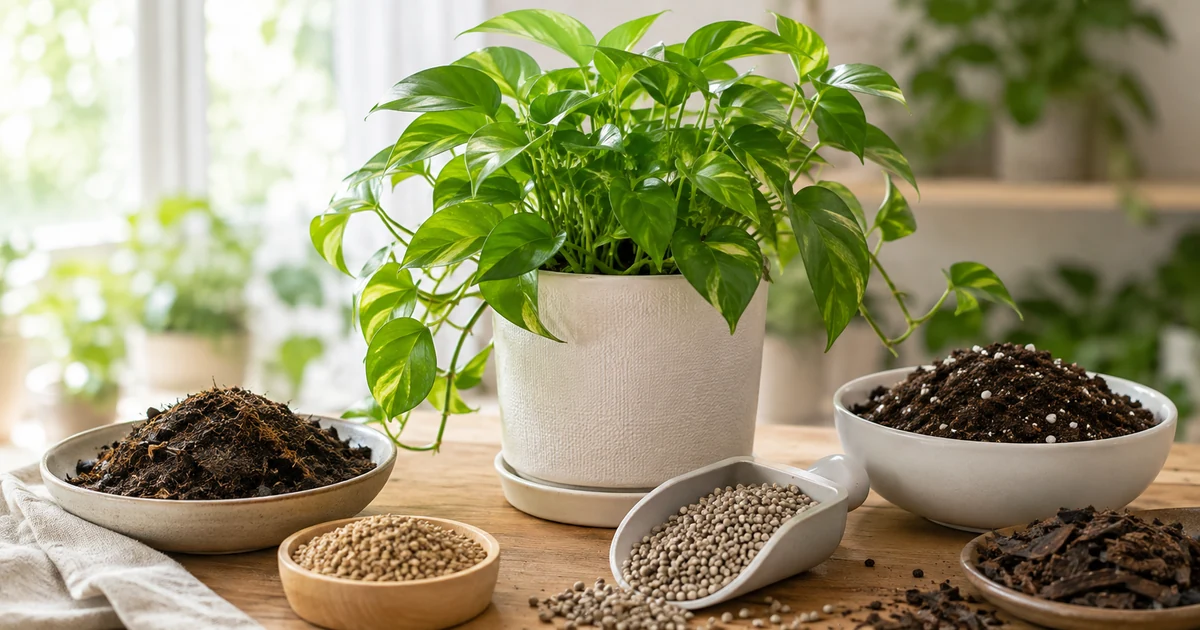
Fertilizer is also different from a soil amendment. A fertilizer is chosen mainly for its nutrient content. An amendment such as compost may add some nutrients, but its main value can be improving soil structure, water movement, or organic matter. Potting mix is a root environment, not a fertilizer; some mixes contain a starter charge of nutrients, while others contain little or none. Read the mix label before adding more.
Adding fertilizer cannot repair roots injured by persistent wetness, make a low-light location brighter, or cure a pest or disease. In those cases, feeding can leave the real cause untreated and may add salt stress to an already weakened root system.
The Nutrients on—and Beyond—the N-P-K Label
Plants need several essential nutrients, but they do not use all of them in equal amounts. The three numbers prominently printed on most fertilizer labels refer to the primary macronutrients:
- Nitrogen (N) is part of chlorophyll, amino acids, and proteins. It supports foliage and shoot growth, but excess nitrogen can encourage soft growth and may delay flowering or increase susceptibility to some problems.
- Phosphorus (P) is involved in energy transfer, cell division, and root and reproductive development. More phosphorus does not automatically produce more flowers, especially when the growing medium already contains enough.
- Potassium (K) helps regulate water balance, enzyme activity, and many processes involved in overall plant function and stress response.
Plants also need secondary nutrients, including calcium, magnesium, and sulfur. They need micronutrients such as iron, manganese, zinc, copper, boron, molybdenum, chlorine, and nickel in much smaller quantities. “Micro” describes the amount required, not the importance of the nutrient.
A complete fertilizer may contain more than N, P, and K, but the exact formulation needed depends on the plant, medium, irrigation water, and existing nutrient supply. A soil or tissue test is more reliable than leaf color alone when a specific deficiency is suspected.
How to Read a Fertilizer Label
The three numbers in a grade such as 10-10-10 are percentages by weight. In the United States, they represent total nitrogen, available phosphate, and soluble potash in that order. A 10-pound bag of 10-10-10 contains 1 pound represented by each of those three figures; the rest is carrier material and possibly other declared nutrients.
The numbers describe concentration, not quality. A 20-20-20 product is more concentrated than a 10-10-10 product, but it is not automatically better. It normally requires a different measured dose. Applying both at the same rate could deliver twice as much of the represented nutrients from the 20-20-20 product.
| Label detail | What it tells you | How to use it |
|---|---|---|
| N-P-K grade | The guaranteed percentages represented by nitrogen, phosphate, and potash | Compare concentration and nutrient balance; do not choose by the largest numbers |
| Guaranteed analysis | Which nutrients are present and in what declared amounts | Check for any secondary nutrient or micronutrient you actually need |
| Application rate | How much product to use for a stated area, container, or volume of water | Measure accurately; do not estimate a stronger dose |
| Frequency and crop directions | Where, when, and how the product is intended to be used | Follow the label for the specific plant and growing situation |
| Warnings and storage directions | Handling, environmental, and safety limits | Keep the product in its original container and follow every precaution |
For garden soil, a soil test can guide both product choice and rate. For a houseplant, first check whether the potting mix already contains fertilizer and whether a controlled-release product is still active.
Fertilizer Types and Their Tradeoffs
Fertilizers can be grouped by how they are formulated, applied, and released. These categories overlap: a product can be granular and controlled-release, or organic-source and granular.
| Type | Practical advantage | Important limitation |
|---|---|---|
| Liquid or water-soluble | Easy to dilute and distribute through a container; nutrients can become available quickly | Errors in measuring or frequent use can contribute to salt buildup; nutrients may leach from containers |
| Granular | Convenient for garden beds and measured surface or incorporated applications | Uneven placement can concentrate fertilizer near roots; release speed varies by product |
| Slow-release or controlled-release | Supplies nutrients over time and reduces the need for frequent applications | Release depends on the formulation and conditions; adding another fertilizer can unintentionally double-feed |
| Organic-source | Nutrients come from plant, animal, or naturally occurring mineral sources; some products also add organic matter | Nutrient concentration and release can be less predictable, and “organic” does not mean risk-free |
| Synthetic or mineral | The analysis is usually specific and nutrients may be readily available | Concentrated products are easy to overapply and do not by themselves improve soil structure |
“Slow-release” and “controlled-release” are sometimes used casually as if they mean the same thing. A controlled-release product commonly uses a coating that meters nutrient release. Many organic fertilizers release nutrients as soil organisms break them down. The product label is the best guide to how a particular formulation behaves.
Does the Plant Need Fertilizer Now?
Use the following checks before reaching for a product. A “no” does not always prohibit feeding, but it should make you investigate before applying more.
| Question | What it tells you | What to do next |
|---|---|---|
| Is the plant actively producing healthy growth? | A growing plant is more likely to use added nutrients than a dormant or severely stressed plant | Match feeding to the species and its actual growth, not a fixed calendar |
| Are the roots firm and the growing medium draining normally? | Damaged roots cannot take up water and nutrients normally | Correct the root-zone problem before fertilizing |
| Does the potting mix already contain a starter or controlled-release fertilizer? | A recent nutrient charge may still be supplying the plant | Check the bag or nursery label and avoid overlapping products |
| Has the plant been fertilized recently? | Repeated applications can accumulate salts even when symptoms continue | Review the product, dose, and dates before adding more |
| Was the plant recently repotted? | Fresh commercial mix may already contain nutrients, and disturbed roots need stable conditions | Follow the mix and plant guidance rather than feeding automatically |
| Do symptoms match watering, light, pest, temperature, or root stress? | Yellowing and slow growth have many non-nutritional causes | Use a structured plant diagnosis first |
| Is the plant in a container or in the ground? | Containers have limited medium and lose soluble nutrients through drainage; garden soil can be tested | Use a container-specific approach or base ground applications on a soil test |
| Is the product labeled for this plant and setting? | Formulations and application rates are not interchangeable | Choose an appropriate product and follow its directions |
Why Yellow Leaves Do Not Prove a Deficiency
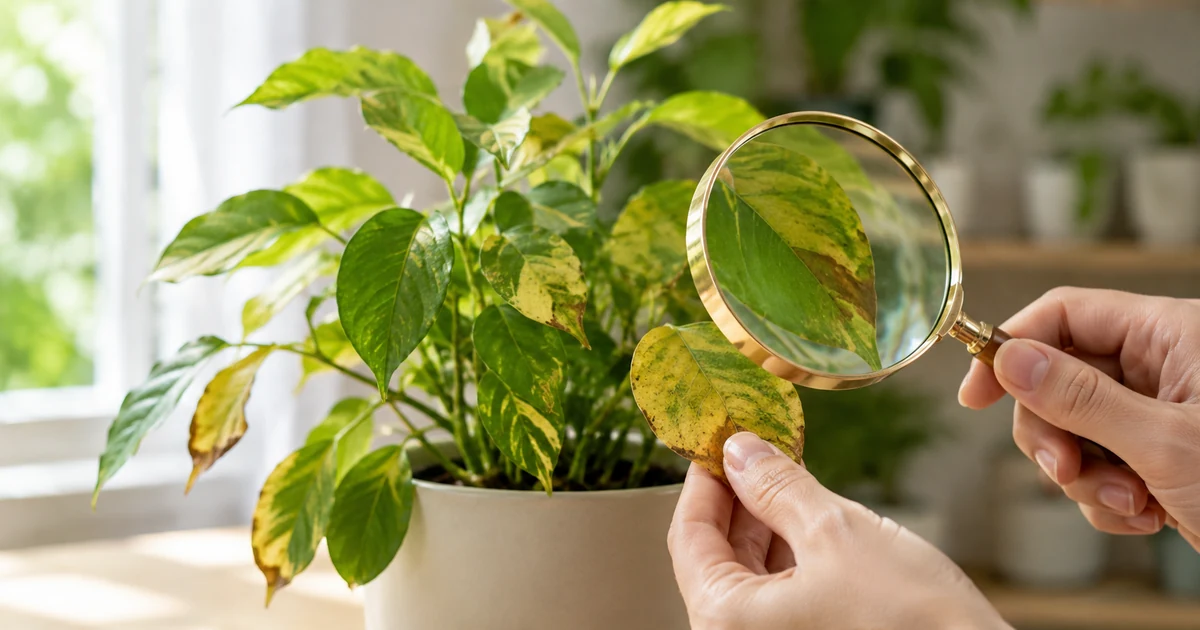
Nutrient shortages can cause discoloration or weak growth, but the same symptoms may occur when roots are too wet, too dry, restricted, injured, or unable to access nutrients because the pH is unsuitable. Low light, temperature stress, pests, disease, natural leaf aging, and excess fertilizer can also cause yellowing.
Look at the pattern before deciding. Which leaves are affected: older or newer, upper or lower, one branch or the whole plant? Did the change follow repotting, relocation, a cold draft, a watering problem, or a fertilizer application? Check the root-zone moisture and plant history. If the evidence still points to nutrition, use a soil or tissue test where practical rather than guessing at one nutrient.
For indoor plants, watering technique and available light often deserve review before feeding. Fertilizer will not compensate for either problem.
Containers and Garden Soil Need Different Decisions
Container roots depend on a small volume of potting mix. Regular watering carries soluble nutrients out through drainage holes, so actively growing container plants may eventually need replenishment. At the same time, salts can accumulate when fertilizer is applied faster than the plant uses it, when drainage is poor, or when little water leaves the pot.
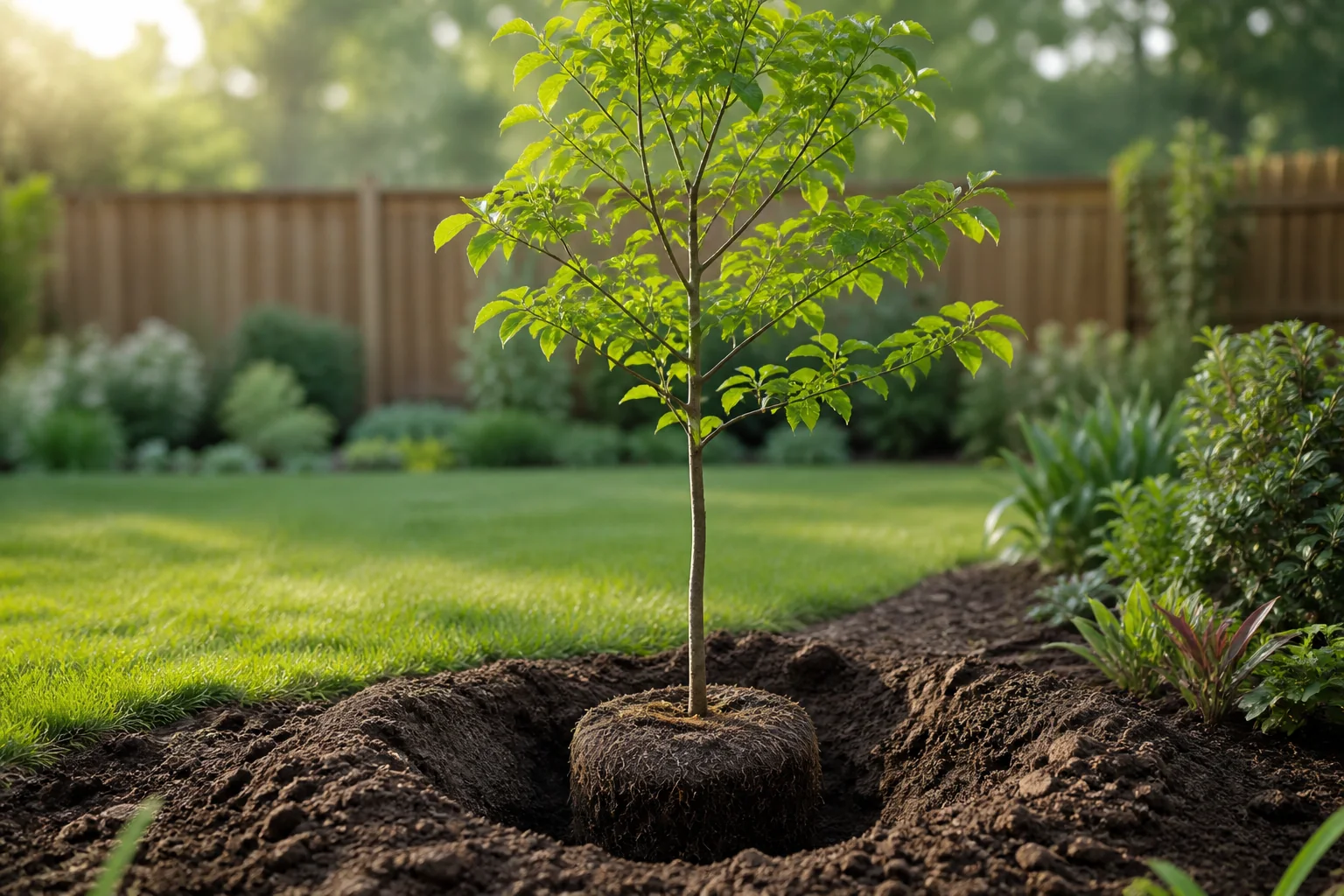
Garden plants draw from a larger soil volume. Nutrient supply depends on soil texture, organic matter, pH, previous applications, and crop removal. A laboratory soil test can show whether an application is justified and can help avoid adding phosphorus or other nutrients that are already sufficient.
Growth stage matters in both settings. Seedlings, newly transplanted plants, actively growing foliage plants, flowering or fruiting crops, and plants resting under seasonal low light do not necessarily need the same formulation or rate. There is no reliable universal monthly schedule.
How to Apply Fertilizer Safely
- Identify the plant and confirm that added nutrients are appropriate.
- Read the full label before measuring. Use the supplied measure when one is provided.
- Calculate the dose for the actual container, area, or water volume. Do not make a stronger mixture to “catch up.”
- Apply only by a method the label permits. Keep granules or concentrated solution away from foliage, stems, and roots when the directions require it.
- Account for every fertilizer source, including fortified potting mix, controlled-release pellets, and recent liquid feeding.
- Avoid feeding a severely wilted, waterlogged, pest-damaged, or root-damaged plant until the primary problem is understood.
- Prevent granules and solution from entering drains, stormwater, ponds, or waterways. Apply only what the plant and label call for.
Recognizing and Responding to Overfertilization
Too much soluble fertilizer can increase the salt concentration around roots, making water uptake more difficult and injuring root tissue. Possible clues include browning at leaf tips or margins, wilting despite available moisture, slowed growth, a visible crust on the medium or pot, and roots that are damaged rather than firm. These clues are not unique to fertilizer injury, so review the application history and root-zone conditions before concluding that salts are the cause.
Stop additional feeding while you assess the plant and product. If excess soluble fertilizer is the likely problem and the container drains freely, slowly leaching the medium with clean water may carry some salts out through the drainage holes. Do not use that advice blindly: a waterlogged container, severely deteriorated roots, poor drainage, or an excess of controlled-release pellets can require a different response. With controlled-release products, additional water may trigger further release rather than solve the problem. Follow the product label and seek local extension guidance for valuable plants or uncertain cases.
Rapid, lush growth is not always healthy growth. Excess nitrogen can produce soft, weak tissue, alter flowering, and create a plant that is harder to manage. The aim is adequate nutrition, not maximum fertilizer.
A Better Fertilizer Decision
Choose fertilizer only after you understand the plant, its root environment, its recent care, and the nutrients already present. Read the guaranteed analysis and rate together, because concentration without dosage is incomplete information. When symptoms are the reason for feeding, diagnose first. When feeding is justified, measure carefully, follow the label, and watch the plant’s response before making another change.
Sources
- RHS — Fertilisers: Types and Uses
- University of Minnesota Extension — Fertilizing and Watering Container Plants
- University of Minnesota Extension — Interpreting Soil Tests for Fruit and Vegetable Crops
- University of Georgia Cooperative Extension — Understanding Fertilizer Labels, Macronutrients, and Micronutrients
- Oregon State University Extension — How to Choose the Best Fertilizer for Your Plants