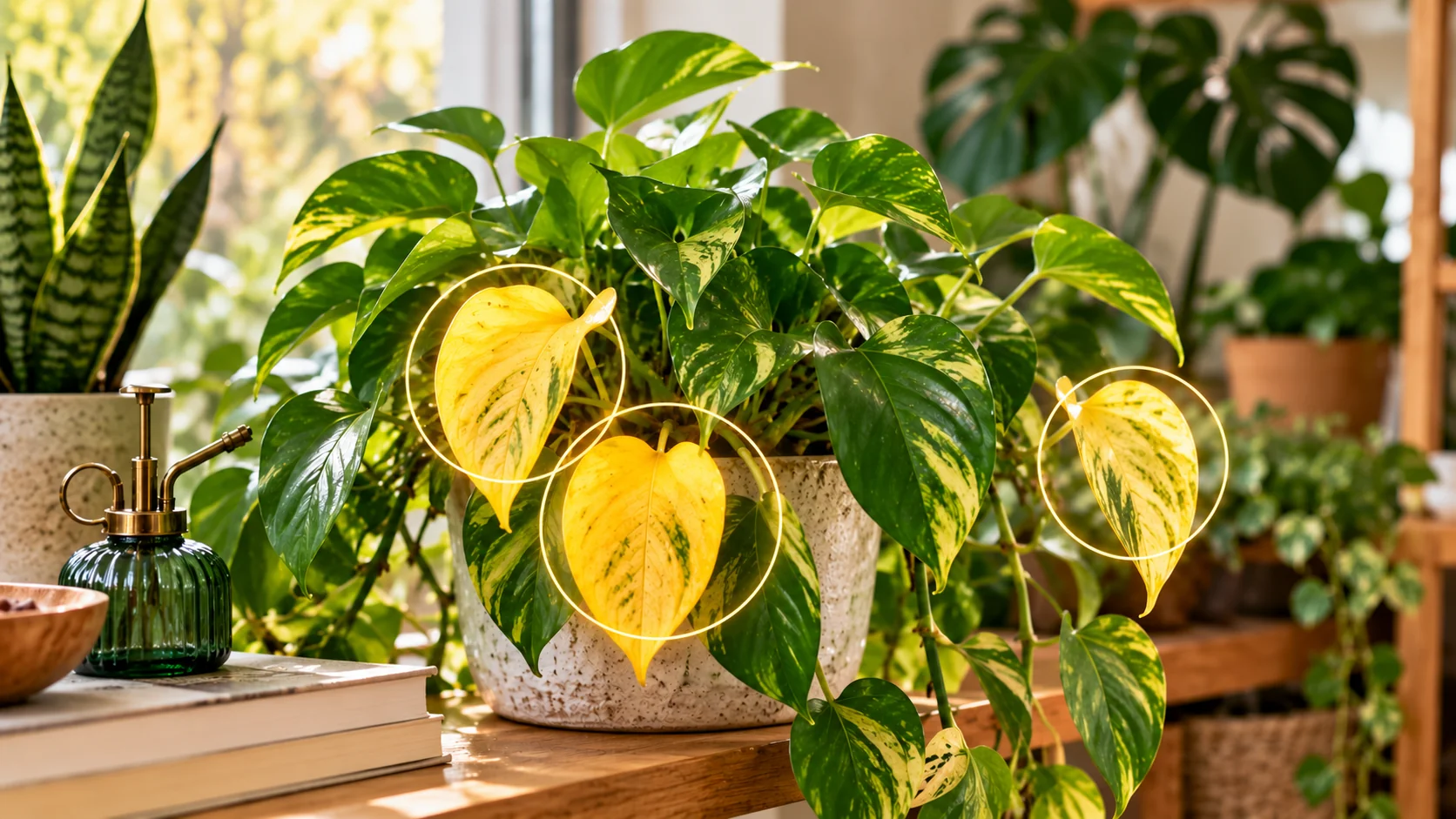
A pothos is often considered one of the easiest houseplants to grow, so yellow leaves can be confusing. If your pothos leaves are turning yellow, don't immediately assume the plant is dying. Yellowing is a symptom, not a diagnosis.
The cause can be something as simple as an old leaf naturally reaching the end of its life, or it can indicate overwatering, poor drainage, root damage, insufficient light, excessive sunlight, underwatering, pests, temperature stress, or another growing-condition problem.
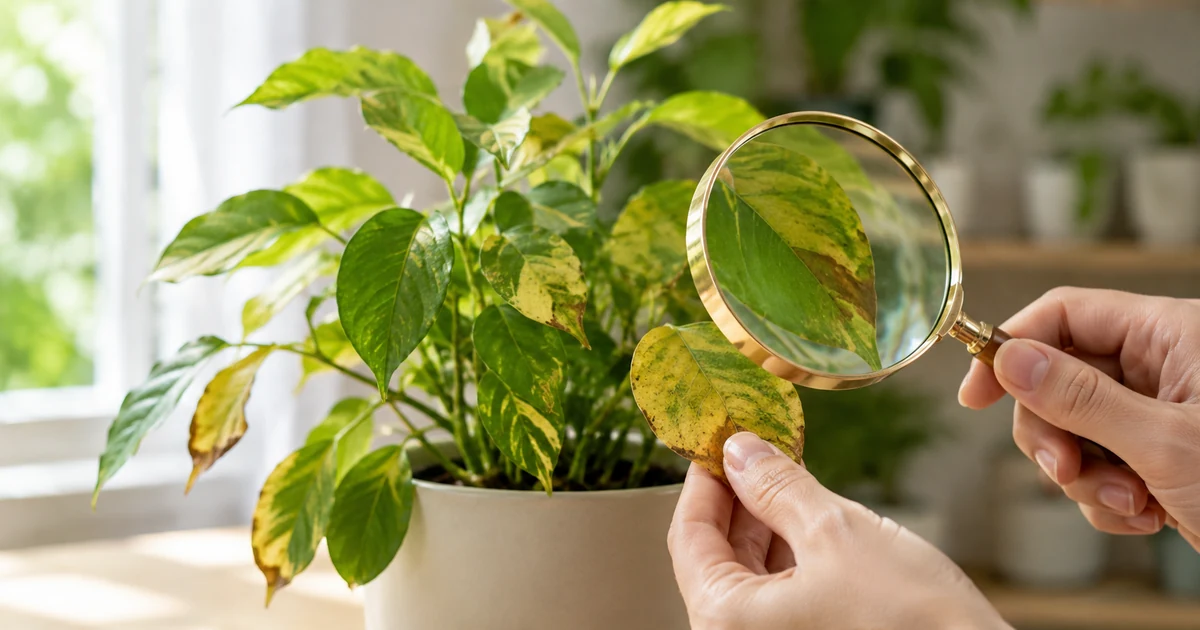
The best way to understand yellow pothos leaves is to look at where the yellowing occurs, how quickly it is spreading, what the soil feels like, and what the roots look like.
Why Is My Pothos Turning Yellow?
The most common cause is excess moisture around the roots. Pothos prefers soil that dries between waterings, and constantly wet soil can reduce oxygen around the roots and contribute to root damage. University of Maryland Extension identifies overwatering as a leading cause of yellowing in indoor plants.
However, yellowing can have several different causes.
The most common include:
- Overwatering
- Poor drainage
- Root rot
- Underwatering
- Too much direct sunlight
- Too little light
- Natural aging
- Nutrient deficiencies
- Pest infestations
- Temperature stress
- Recent repotting or environmental changes
- Soil that stays wet for too long
Before changing your care routine, look at the whole plant rather than the yellow leaf alone.
1. Overwatering Is the Most Common Cause
If your pothos has several yellow leaves and the soil is still wet, start by checking your watering habits.
Pothos does not need constantly moist soil. When the growing medium remains saturated, air spaces in the soil become filled with water. Roots need oxygen as well as moisture, so prolonged wet conditions can damage them.
Signs your pothos may be overwatered
Look for a combination of:
- Several yellow leaves
- Yellowing that starts on lower or inner leaves
- Soil that stays wet for many days
- Soft or limp leaves
- A heavy pot
- Slow or weak growth
- A musty or unpleasant smell from the soil
- Brown or mushy roots
Overwatering doesn't necessarily mean you poured too much water into the pot one time. More often, it means the plant is being watered again before the root zone has had enough time to dry.
How to fix an overwatered pothos
First, stop watering until the soil has dried appropriately.
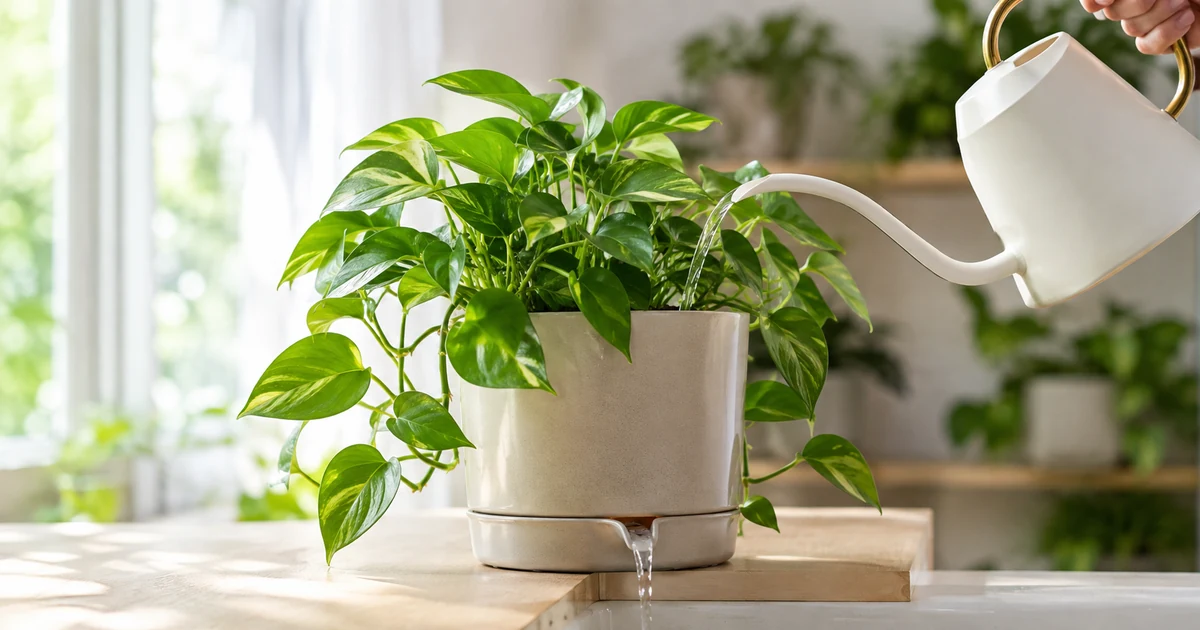
Then check the drainage. Your pot should have drainage holes that allow excess water to escape. Never allow the inner pot to sit in a saucer or decorative container filled with standing water.
If the soil remains wet for an unusually long time, the problem may be the potting mix, container size, drainage, or growing conditions rather than simply your watering frequency.
Penn State Extension recommends watering pothos when the soil is dry and notes that excessive moisture can lead to root rot.
2. Root Rot Can Make Pothos Leaves Yellow
If your pothos continues turning yellow even though the soil is wet, check the roots.
Root rot is commonly associated with excessive moisture and poor drainage. Damaged roots cannot function normally, which can result in yellowing, wilting, poor growth, and leaf drop.
What healthy pothos roots look like
Healthy roots should generally be:
- Firm
- Light-colored
- Not slimy
- Not mushy
- Free from a strong rotten smell
Damaged roots may be:
- Brown or black
- Soft
- Mushy
- Weak
- Easily pulled apart
How to treat root rot
If you find significant root damage:
- Remove the pothos carefully from its container.
- Gently remove excess wet soil around the roots.
- Inspect the entire root system.
- Trim away severely damaged, mushy roots with clean scissors.
- Repot the healthy portion into fresh, well-draining potting mix.
- Use a container with drainage holes.
- Place the plant in bright, indirect light.
- Avoid immediately soaking the new potting mix repeatedly.
If most of the root system is severely damaged, healthy vine cuttings can sometimes provide a way to propagate a new plant.
3. Your Pothos May Not Be Getting Enough Light
Pothos is tolerant of lower light, but low-light tolerance does not mean low light is ideal.
When light levels are too low, growth can become weak and stretched. Variegated pothos may also lose some of its characteristic coloration. Penn State recommends moderate to bright light and notes that prolonged low light can reduce desirable foliage characteristics.
Signs of insufficient light
You may notice:
- Long spaces between leaves
- Small new leaves
- Slow growth
- Loss of variegation
- Leaves becoming pale
- Yellowing and eventual leaf drop
- Vines reaching toward a window
Move the plant gradually toward a brighter location with bright, indirect light.
Avoid placing it directly against a window with intense afternoon sunlight.
4. Too Much Direct Sun Can Also Cause Yellow Leaves
Pothos doesn't automatically prefer more light.
Strong, direct sunlight can cause leaves to become bleached, yellow, or damaged. Penn State specifically recommends avoiding direct sun for pothos.
If yellow or pale areas appear mainly on the side of the plant facing a bright window, excessive sunlight could be contributing.
What to do
Move your pothos farther away from the window or filter intense sunlight with a sheer curtain.
A bright room with indirect light is generally a better environment than several hours of harsh direct sun.
5. Underwatering Can Turn Pothos Leaves Yellow
Although overwatering is a common problem, pothos can also suffer when the soil becomes extremely dry for extended periods.
Check the soil rather than watering according to a fixed calendar.
Signs of underwatering
An underwatered pothos may have:
- Very dry potting soil
- Drooping leaves
- Curling foliage
- Crispy brown edges
- A lightweight pot
- Leaves that become yellow and eventually dry out
If the soil has become extremely dry and pulled away from the sides of the container, water thoroughly and allow excess water to drain.
The goal isn't to keep pothos constantly dry. The goal is to avoid both waterlogged soil and prolonged drought.
6. One Yellow Lower Leaf May Be Completely Normal
Not every yellow leaf means something is wrong.
If your pothos is otherwise healthy and one of the oldest leaves near the base slowly turns yellow, natural aging may be responsible.
Plants eventually shed older foliage as they redirect resources toward newer growth.
This is especially easy to notice on mature pothos vines because older leaves are shaded by newer foliage.
When natural aging is more likely
- Only one older leaf is yellow
- The rest of the plant looks healthy
- New leaves are developing normally
- The soil isn't constantly wet
- There are no obvious pests
- The yellowing happens gradually
In this situation, you generally don't need to dramatically change your plant care.
7. Nutrient Deficiency Can Cause Yellowing
Pothos growing in the same container for a long time can eventually use available nutrients in the growing medium.
A nutrient deficiency may cause pale or yellow foliage, but don't assume every yellow leaf needs fertilizer.
Watering, drainage, light, and root health should be checked first because these problems are more common and can produce similar symptoms.
If your pothos has appropriate light, healthy roots, suitable watering, and fresh growing conditions but still shows persistent pale growth, a balanced houseplant fertilizer may be appropriate during active growth.
Avoid excessive fertilizing. More fertilizer isn't automatically better and can create additional stress.
8. Pests Can Cause Yellow Pothos Leaves
Inspect your pothos carefully if yellowing is accompanied by unusual spots, speckling, sticky residue, or webbing.
Common houseplant pests include:
- Spider mites
- Aphids
- Mealybugs
- Scale insects
- Whiteflies
Spider mites, for example, feed on the undersides of leaves and may produce fine webbing. Aphids and other sap-feeding insects can also contribute to leaf discoloration.
How to check for pests
Look closely at:
- Leaf undersides
- New growth
- Leaf joints
- Stems
- Areas where leaves meet the vine
If you find pests, isolate the affected pothos from other houseplants and choose an appropriate treatment based on the specific pest.
9. Temperature Stress Can Cause Yellowing
Pothos is a tropical plant, so sudden temperature changes can cause stress.
Keep pothos away from:
- Cold drafts
- Frequently opened exterior doors
- Air-conditioning vents
- Very hot heating vents
- Extremely cold windows
Penn State recommends normal warm indoor temperatures around 60–80°F (16–27°C) for pothos.
If yellowing started shortly after moving the plant, changing rooms, or exposing it to a cold or hot draft, environmental stress may be contributing.
10. Repotting Can Temporarily Stress Your Pothos
If your pothos started yellowing shortly after repotting, don't automatically assume the new pot is killing it.
Repotting changes the root environment and can temporarily stress a plant, especially if the roots were heavily disturbed.
The bigger concern is whether the new container is too large or poorly draining.
A much larger pot can hold more moisture around the roots for longer, increasing the risk of overwatering.
After repotting, monitor the soil moisture and avoid watering simply because the plant was moved into a new container.
How to Diagnose Yellow Pothos Leaves
Instead of guessing, use this simple troubleshooting process.
Step 1: Check the soil
Push your finger into the potting mix rather than checking only the surface.
Soil is still very wet
Think about:
Overwatering → poor drainage → root stress → possible root rot
Soil is extremely dry
Consider:
Underwatering → drought stress → yellowing and crispy foliage
Soil is moderately dry
Your watering routine may be reasonable, so check light, roots, pests, temperature, and natural aging.
Step 2: Look at Which Leaves Are Turning Yellow
The location of yellow leaves can provide useful clues.
Older lower leaves
Possible causes:
- Natural aging
- Overwatering
- Root stress
- Low light
Several leaves at once
Check:
- Soil moisture
- Drainage
- Root health
- Recent environmental changes
New leaves turning yellow
Check more carefully for:
- Root problems
- Nutrient issues
- Pests
- Severe environmental stress
Leaves facing a sunny window
Consider excessive direct sunlight.
Step 3: Check How the Yellowing Looks
The appearance of the leaf can also help.
Soft, uniform yellow leaves + wet soil
Overwatering or root stress becomes more likely.
Yellow leaves + crispy brown edges + very dry soil
Underwatering or drought stress may be involved.
Pale or bleached patches near strong sunlight
Consider sun damage.
Tiny yellow spots or speckling + webbing
Inspect carefully for spider mites.
One yellow older leaf + healthy new growth
Natural aging may be the explanation.
Remember that symptoms can overlap. University of Maryland Extension recommends considering the pattern and progression of symptoms because different environmental stresses can produce similar signs.
Should You Cut Off Yellow Pothos Leaves?
You can remove leaves that are completely yellow, badly damaged, or dying.
Use clean, sharp scissors and cut the leaf stem close to the main vine.
However, pruning the yellow leaf does not solve the underlying problem.
If overwatering caused the yellowing, cutting off leaves without correcting the watering problem will not stop additional leaves from turning yellow.
Think of pruning as cleanup—not treatment.
Can a Yellow Pothos Leaf Turn Green Again?
A leaf that has become completely yellow generally will not return to its original green appearance.
Instead of trying to restore one damaged leaf, focus on the plant's future growth.
Correct:
- Watering
- Drainage
- Light
- Root health
- Temperature
- Pest problems
- Nutrient management
Healthy new leaves are a better indication that your pothos is recovering.
How to Prevent Pothos Leaves From Turning Yellow
Good pothos care is mostly about avoiding extremes.
Provide appropriate light
Keep your pothos in bright, indirect light. Avoid prolonged harsh direct sunlight.
Water according to soil moisture
Don't water simply because it is a certain day of the week. Check the soil first.
Use good drainage
Choose a container with drainage holes and a potting mix that does not remain saturated for long periods.
Don't let the plant sit in water
Empty excess water from the saucer or decorative container.
Monitor the roots
If yellowing continues while the soil stays wet, inspect the root system.
Check for pests
Regularly examine leaves, stems, and new growth.
Avoid temperature extremes
Keep the plant away from cold drafts and hot air vents.
Don't overfertilize
Only fertilize when the plant needs additional nutrients and follow the product instructions.
Penn State's basic pothos recommendations are simple: provide moderate to bright light, avoid direct sun, water when the soil is dry, and use a well-draining growing medium.
Frequently Asked Questions About Yellow Pothos Leaves
Why are my pothos leaves turning yellow all of a sudden?
Sudden yellowing can be associated with a change in watering, temperature, light, root conditions, pests, or another environmental stress. Check the soil and recent changes in the plant's environment first.
Why are my pothos leaves turning yellow and falling off?
Yellowing followed by leaf drop can happen when the plant is under prolonged stress. Overwatering and root problems are important possibilities, particularly when the soil stays wet. Environmental stress and natural aging can also cause leaves to drop.
Why are only the bottom leaves of my pothos turning yellow?
One old bottom leaf turning yellow can be normal aging. If several lower leaves are becoming yellow while the soil remains wet, investigate overwatering, poor drainage, and root health.
Can overwatering cause yellow pothos leaves?
Yes. Excess moisture is one of the most common causes of yellowing in indoor plants. Waterlogged soil reduces oxygen available to roots and can contribute to root damage.
How often should I water my pothos?
Don't rely on a strict weekly schedule. Check the soil and water when it has dried appropriately. The drying rate depends on factors such as light, temperature, humidity, pot size, and potting medium.
Does pothos need direct sunlight?
No. Pothos generally performs well in moderate to bright indirect light. Strong direct sunlight can damage or yellow the foliage.
Should I remove yellow leaves from my pothos?
Yes, completely yellow or badly damaged leaves can be removed. But always identify the cause of the yellowing first so new leaves don't develop the same problem.
Is a yellow pothos always dying?
No. A single old yellow leaf can be completely normal. Even when yellowing is caused by a care problem, correcting the underlying issue can allow the plant to produce healthy new growth.
Final Thoughts
When you ask, “Why is my pothos turning yellow?”, don't look at the leaf alone.
Start with the soil. Then check the roots, light, drainage, pests, temperature, and age of the affected leaves.
If several leaves are yellow and the soil is consistently wet, investigate overwatering and root problems first. If the soil is extremely dry, consider underwatering. If the plant is stretched and pale, evaluate its light. And if only one old lower leaf is yellow while the rest of the plant looks healthy, natural aging may be all that's happening.
The goal isn't simply to remove yellow leaves. It's to identify why they turned yellow in the first place and correct the condition so your pothos can continue producing healthy green foliage.