
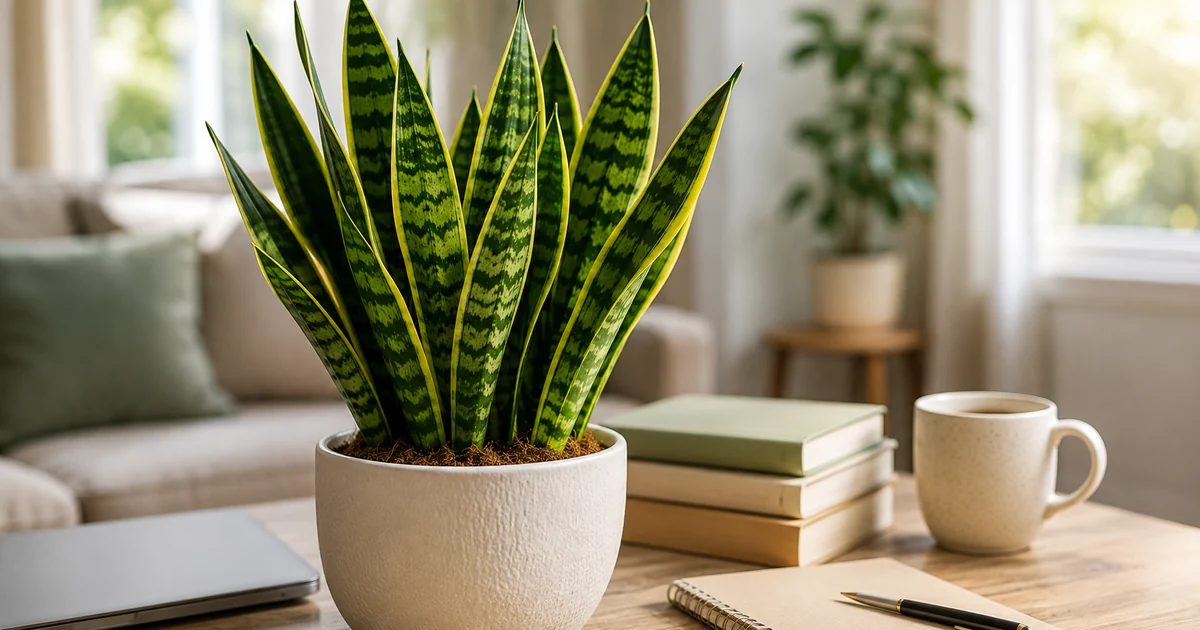
The strongest reasons to choose a snake plant are practical: upright architectural foliage, tolerance of drying between waterings, adaptability across a range of indoor light, and cultivars that fit different spaces. It is not a substitute for ventilation, an air cleaner, a sleep treatment, or a pet-safe plant.
This evidence-based guide separates useful advantages from claims that are often repeated beyond what the research supports.
Snake Plant Claims: Evidence and Practical Meaning
| Claim | Evidence level | Practical meaning |
|---|---|---|
| Tolerates missed watering | Strong horticultural support | Fleshy leaves and rhizomes make it forgiving of some drying, but roots can rot in persistently wet mix |
| Tolerates lower light | Strong horticultural support | It may survive low light; brighter indirect light generally supports stronger growth |
| Has a compact footprint | Depends on cultivar | Upright leaves use vertical space, but standard plants can reach several feet; choose a dwarf cultivar for a desk |
| Is easy to propagate | Supported | Division and offsets are dependable; leaf cuttings may not preserve variegation |
| “Purifies household air” | Unsupported at ordinary plant densities | Sealed-chamber VOC removal does not show that one pot meaningfully cleans a ventilated room |
| “Releases enough oxygen at night to improve sleep” | Unsupported health claim | CAM physiology does not make a bedroom plant a clinically meaningful oxygen source |
| Is safe around pets | False | ASPCA lists snake plant as toxic to cats and dogs if eaten |
| Is maintenance-free | False | It still needs appropriate light, drainage, pest checks, and condition-based watering |
Practical Advantages That Hold Up
Upright form uses space efficiently
Snake plants grow as rosettes or clumps of stiff, vertical leaves. That architectural habit can fit a narrow floor area better than a wide, trailing plant. Size varies greatly: dwarf “bird’s nest” cultivars suit shelves and desks, while standard *Dracaena trifasciata* can reach several feet tall and should be treated as a floor plant.
Decorative value is subjective, but the range of banded, silver, green, yellow-edged, cylindrical, and compact forms is real. Choose by mature dimensions and leaf form rather than assuming every snake plant remains narrow.
It tolerates drying better than many foliage plants
The leaves and rhizomes store water. NC State Extension describes the species as resistant to drought and dry soil, while also warning that overwatering causes root rot. This makes a snake plant useful for someone who occasionally waters late—not someone who wants to ignore a plant permanently.
The safe practical rule is to assess the root zone before watering. Pot size, mix, light, temperature, and season change drying time, so use condition-based Snake Plant watering instead of a fixed monthly promise.
It handles a range of indoor light
Snake plants tolerate low light and also grow in brighter positions when protected from abrupt, harsh exposure. “Tolerates” is the key word: very low light slows growth and water use. A dark corner with no meaningful natural or artificial plant light is not equivalent to a shaded habitat.
Our guide to what low light means for plants explains how to evaluate a position. Move a plant accustomed to dim conditions gradually toward stronger light to reduce scorch risk.
Propagation and division are straightforward
Mature clumps produce rhizomes and offsets that can be separated during repotting. Leaf cuttings can also root, but variegated cultivars may produce plain green offspring because the cutting does not always preserve the parent’s chimeral pattern. Division is the safer method when keeping a particular variegation matters.
Propagation is an optional horticultural advantage, not a reason to divide an undersized or unhealthy plant. Wait until the clump has viable roots and growth points.
It is widely available and long-lived under suitable care
The plant’s popularity makes different sizes and cultivars easy to find. With drainage, sensible watering, suitable light, and protection from cold, the same clump can be maintained and divided over time. Longevity still depends on care; it is not guaranteed by the species name.
The Air-Purification Claim in Context
The 1989 NASA work tested plants and growing media for removal of volatile organic compounds in small, sealed experimental chambers. It was valuable controlled research, but those chambers do not reproduce the air volume, ventilation, pollutant sources, and air exchange of an occupied home.
A later review by Cummings and Waring converted results from 12 chamber studies into clean-air delivery rates. The authors estimated that roughly 10–1,000 plants per square metre of floor area would be needed to match the VOC removal already produced by typical building air exchange. That does not mean plants have no biology or no effect inside a chamber; it means a normal number of passive pots should not be marketed as an effective room air-cleaning system.
Choose a snake plant because you enjoy it and can meet its care needs. For indoor air quality, prioritize source control, suitable ventilation, and filtration appropriate to the pollutant—not a single pot.
Oxygen, Sleep, and Wellness Claims
Snake plants use crassulacean acid metabolism (CAM), an adaptation that allows gas exchange patterns different from many plants. That botanical fact is often turned into the claim that a bedroom snake plant releases enough nighttime oxygen to improve sleep or breathing. The leap is unsupported: a small plant’s gas exchange is tiny relative to a room and its occupants, and the cited horticultural sources do not establish a human sleep or medical benefit.
There is likewise no basis here for claiming that snake plants cure headaches, prevent illness, improve breathing, or medically reduce stress. A person may subjectively enjoy greenery or find the plant visually calming, but that preference is not a treatment outcome.
Pet and Household Safety
The ASPCA lists snake plant as toxic to cats and dogs because it contains saponins. Reported signs include nausea, vomiting, and diarrhea. This is a meaningful placement limitation, though it should not be exaggerated into a claim that every exposure is life-threatening.
Keep the plant inaccessible to pets that chew foliage. If ingestion is suspected, contact a veterinarian or animal poison-control service for advice based on the animal and amount involved. Do not use a web article as a substitute for veterinary assessment.
NC State also describes low-severity poisoning characteristics for people and notes that sap can irritate skin. Keep cut material away from children, wash hands after propagation, and do not treat the plant as edible.
Who Is a Snake Plant Actually Good For?
It can be a sensible choice when:
- you have a narrow space suited to upright foliage;
- you prefer a plant whose mix can dry substantially between watering;
- the position receives low to bright indirect light rather than total darkness;
- you can keep it away from pets and young children who may chew it;
- you want a clumping plant that can later be divided.
Choose something else when a curious pet has unrestricted access, when you tend to water every plant frequently, or when the only position is dark and unlit. For full potting, light, and troubleshooting instructions, use the Snake Plant care guide.
Sources
- North Carolina Extension: *Dracaena trifasciata* — growth habit, size, drought and shade tolerance, propagation, and toxicity.
- Royal Horticultural Society: How to Grow Sansevierias — cultivar forms, indoor care, propagation, and safety.
- ASPCA: Snake Plant — toxicity to cats and dogs, toxic principle, and clinical signs.
- NASA Technical Reports Server: A Study of Interior Landscape Plants for Indoor Air Pollution Abatement — original controlled air-pollutant research context.
- Cummings and Waring: Potted Plants Do Not Improve Indoor Air Quality — review translating chamber results into real-building clean-air delivery rates.
- Gilman and Edwards: Relationships Between Leaf Succulence and CAM in *Sansevieria* — primary research on CAM across snake plant relatives.
Related Plant Guides
 INDOOR PLANTS
 INDOOR PLANTS
 INDOOR PLANTS