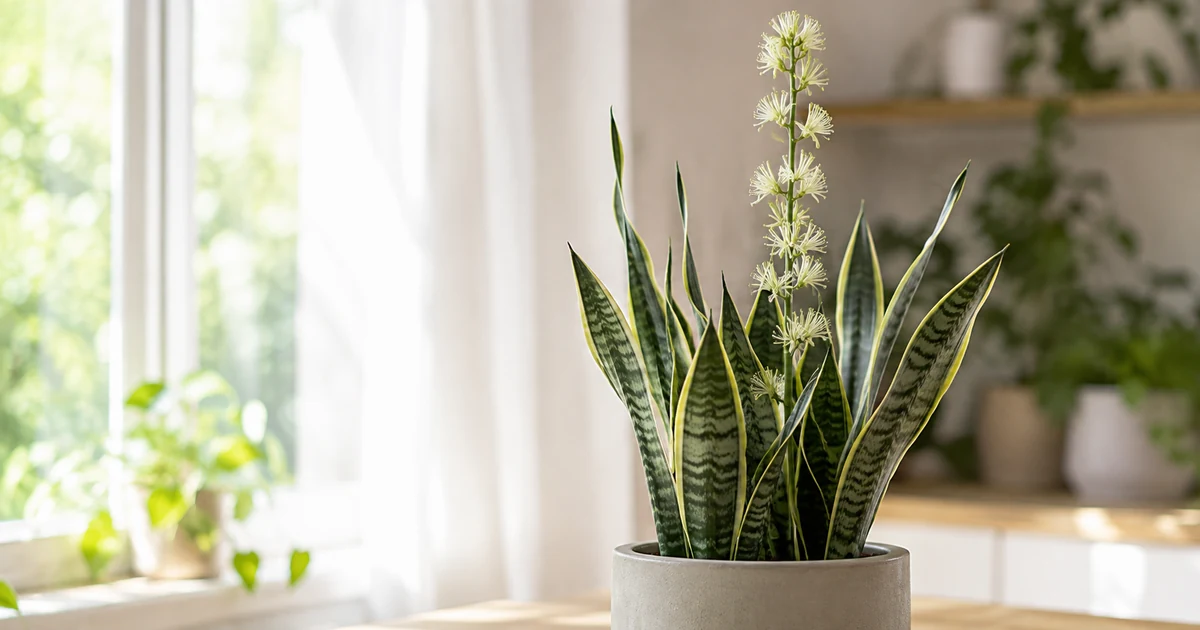
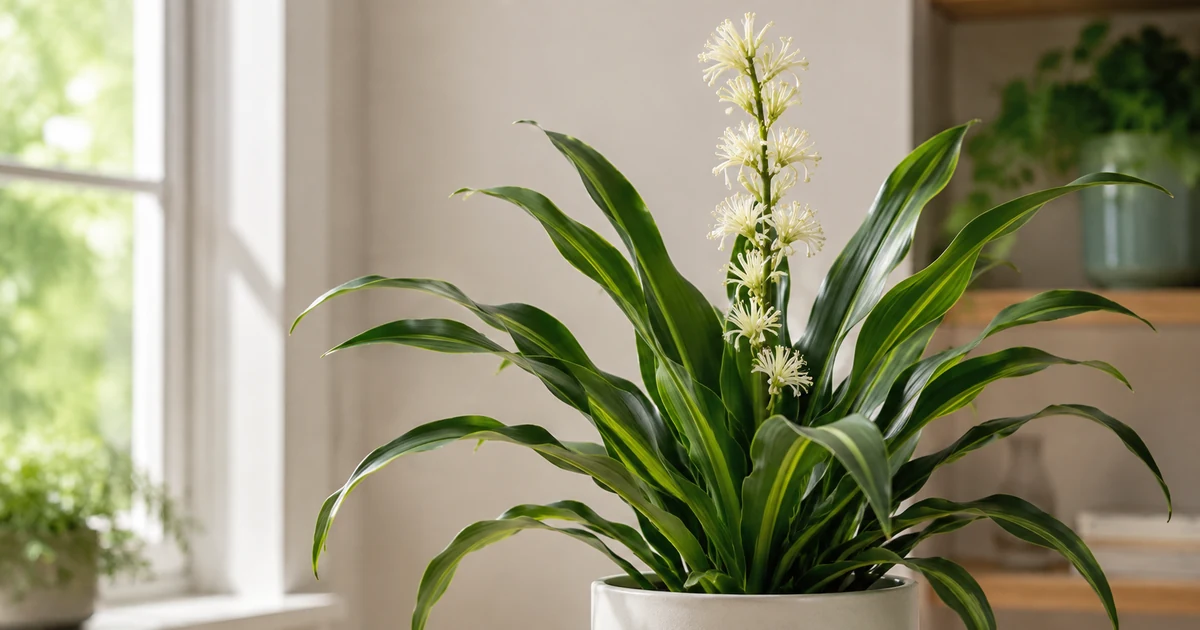
A flowering corn plant is doing something natural but uncommon indoors. Corn plant (*Dracaena fragrans*) is normally grown for its leafy canes, yet a mature specimen can produce a large, branched flower cluster with pinkish buds that open into small white, strongly scented flowers. The bloom alone does not prove that every aspect of care is perfect—and it is not a sign that the plant is dying.
Confirm That It Is a Corn Plant Flower Stalk
The common name “corn plant” refers here to *Dracaena fragrans*, not edible corn. Its inflorescence is a branching panicle that emerges among the leaves. North Carolina Extension describes panicles ranging from 6 to 60 inches long. The individual six-lobed flowers begin pink and open white, often with a fine red or purple line.
New leafy shoots look different: they stay compact and form strap-shaped leaves rather than many rounded buds on branching side stems. A flower stalk may also carry clear, sticky droplets. That residue can be floral nectar rather than a pest product, but inspect the leaves and stems before assuming—soft scale and mealybugs can also make sticky honeydew.
Why Did It Flower Indoors?
The most defensible answer is that the plant is mature enough to reproduce and its recent conditions allowed it to develop an inflorescence. Authoritative references confirm that mature *Dracaena fragrans* can flower and that indoor bloom is rare, but they do not provide a proven household recipe or a single reliable trigger.
Light, temperature, day length, plant maturity, genetics, water status, and the plant’s previous growing conditions may all influence development. A bloom that appears after moving the plant, changing watering, or becoming pot-bound shows timing—not proof that the change caused flowering.
Avoid deliberately stressing the plant to make it bloom. Withholding water, chilling roots, or leaving it severely crowded can cause real damage without producing flowers. Continue sound care and treat the bloom as an occasional reproductive event, not a care score.
What Corn Plant Flowers Are Like
RHS describes woody dracaena flowers as small, white, starry, pink in bud, and highly fragrant. NC State reports that *D. fragrans* flowers are particularly fragrant at night. A plant may open successive groups of flowers, so the scent can seem much stronger in the evening than during the day.
The fragrance can fill a room. If it is uncomfortable, ventilation or temporarily relocating the plant is reasonable. Cutting the stalk is also an option; the plant does not need to complete flowering to remain healthy.
Corn Plant Flowering Decision Aid
| Observation | What it may mean | What to check | What to do |
|---|---|---|---|
| Branched stalk with many pinkish buds | A developing *D. fragrans* inflorescence | Confirm it emerges among the leaf heads and is forming buds, not leaves | Leave it in place if you want the display; keep routine care stable |
| Clear sticky droplets near flowers | Floral nectar is possible | Inspect leaf undersides, canes, and joints for scale or mealybugs | Protect surfaces; treat only if an actual pest is identified |
| Strong fragrance in the evening | Normal flower scent | Whether anyone is sensitive and whether ventilation is adequate | Ventilate, relocate, or remove the stalk if needed |
| Flowers fading and stalk turning brown | The display is finishing | Ensure browning is confined to the flower structure | Cut the spent stalk near its base with clean pruners, or let it dry first |
| Yellowing leaves as well as flowers | A separate care or root issue may be present | Moisture, drainage, cold, salts, pests, and which leaves are affected | Diagnose the foliage problem independently; do not blame flowering automatically |
| Flowering after a move or care change | Coincidence or several interacting cues | The plant’s condition before and after the change | Do not repeat stress deliberately; record the conditions and maintain stable care |
Care While a Corn Plant Is Flowering
Keep the root zone steady
Water according to the moisture in the pot, not because the plant is flowering. RHS recommends moist but well-drained conditions during active growth and less water in winter. Do not leave the mix saturated, and do not add extra fertilizer in an attempt to prolong the flowers.
Maintain suitable light and temperature
Provide bright, indirect light and protect the foliage from harsh sun. Woody dracaenas are tropical; RHS recommends warmth and notes that cold and radiator heat can damage foliage. Avoid relocating the plant repeatedly unless the scent requires it.
Expect nectar and fallen flowers
Put a washable mat beneath the plant if droplets or spent flowers reach furniture. Sticky nectar is not itself evidence of disease. Clean nearby surfaces with water rather than spraying the flower cluster with a household product.
What to Do After Flowering
Once the display is finished, the stalk can be removed with clean, sharp pruners. Cut the flower stalk rather than a leafy cane, taking care not to injure surrounding leaves. There is no need to repot, divide, or change fertilizer simply because the plant bloomed.
Continue watching normal indicators: new leaf growth, pot drainage, root health, and pests. Flowering uses resources, but reputable horticultural references do not describe it as inherently harmful to a healthy corn plant. Another bloom may not occur on a predictable schedule.
When the Bloom Is Not the Main Problem
If leaves are rapidly yellowing, canes feel soft, the mix smells sour, or the plant wilts while wet, investigate roots and drainage promptly. If sticky residue appears well beyond the flowers, inspect for mealybugs and soft scale. Our plant-problem diagnosis guide can help separate flower behavior from a simultaneous care problem.
Sources
- North Carolina Extension: *Dracaena fragrans* — flower structure, panicle size, color, fragrance, and rarity indoors.
- Royal Horticultural Society: Dracaena — mature growth, flower appearance, fragrance, and general requirements.
- Royal Horticultural Society: How to Grow Dracaena — indoor care and occasional flowering of woody dracaenas.
- Royal Horticultural Society: *Dracaena fragrans* — mature flowering, growth habit, cultivation, and pruning context.