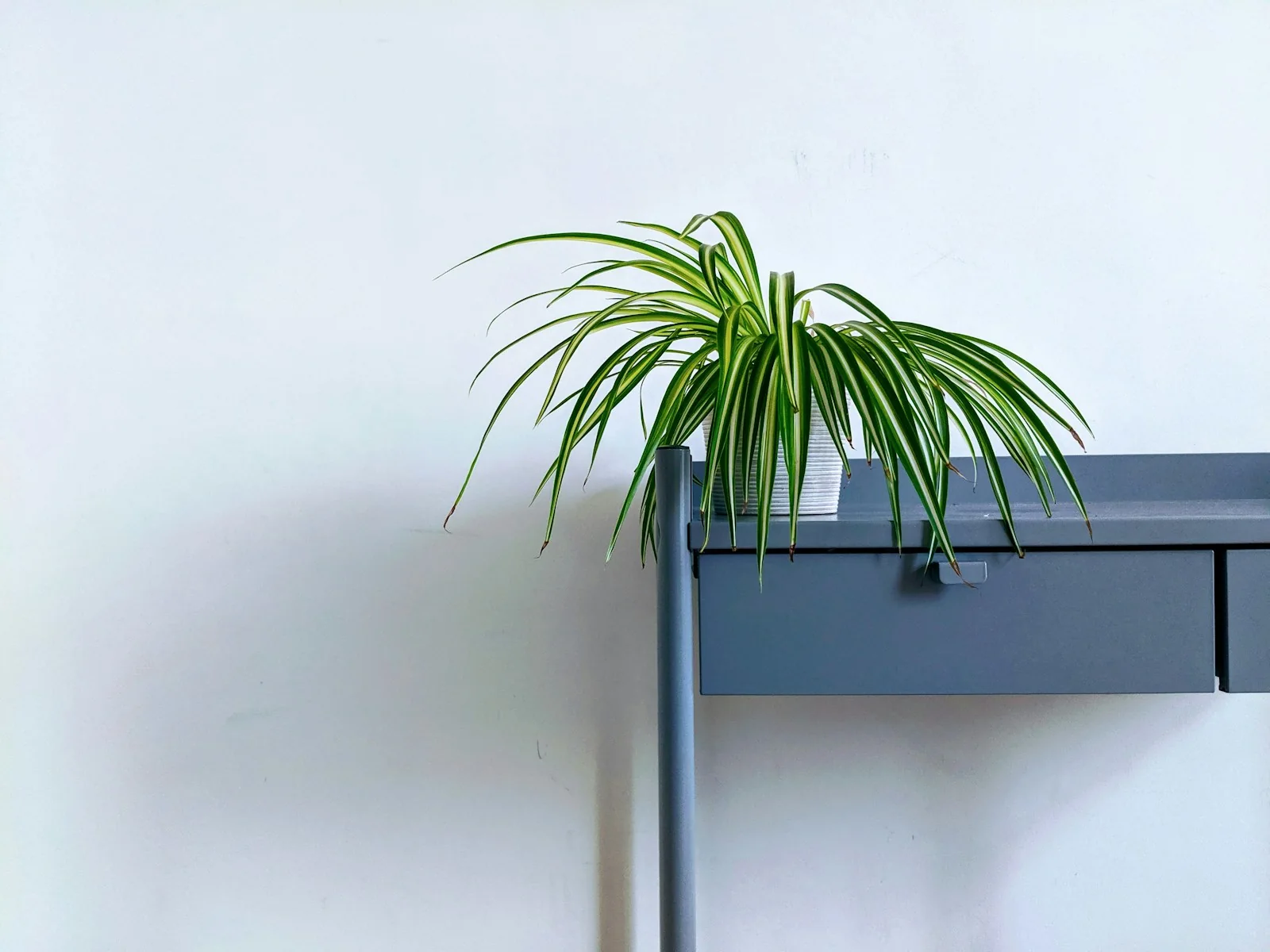
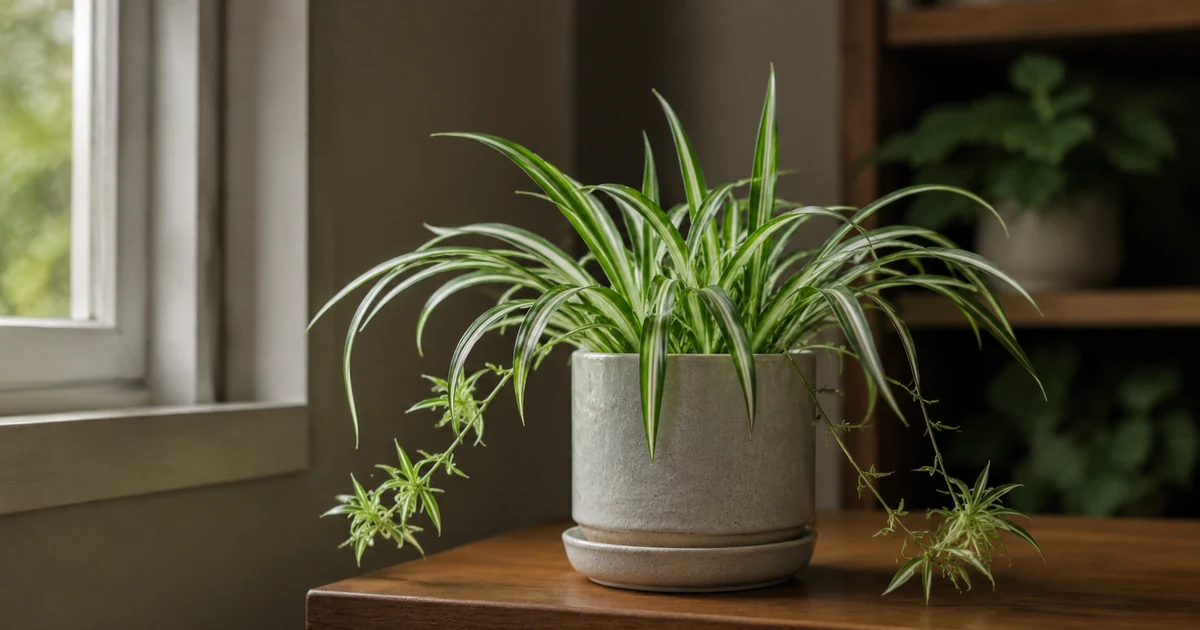
Yes, a spider plant (*Chlorophytum comosum*) can tolerate low light, but tolerance is not the same as strong growth. In a dim position it may remain alive while growing slowly, producing fewer flowers and plantlets, and using water less quickly. Bright, indirect or dappled light is a better target when you want a full plant with active growth.
This guide focuses on deciding whether a particular position is bright enough. For watering, repotting, propagation, and other needs, use our complete Spider Plant care guide.
What Does “Low Light” Mean?
Low light is often described by where a plant sits—such as “several feet from a window”—but distance alone is unreliable. Window direction, glass, curtains, nearby buildings, season, latitude, and even wall color change the light that reaches a leaf.
University of Minnesota Extension groups low light for indoor plants at roughly 50–250 foot-candles. One foot-candle is about 10.8 lux, so that is approximately 540–2,700 lux. This is a broad horticultural category, not an exact spider-plant threshold. Readings also change through the day, and a phone light-meter app is better used to compare positions than as laboratory-grade equipment.
Measure at leaf height, with the plant in its normal position. Take readings at more than one time on a typical day. Our guide to what low light means for plants explains why human eyes can make a room seem brighter than it is to a plant.
Surviving Versus Thriving
The Royal Horticultural Society says spider plants prefer bright, indirect or dappled light but tolerate low light. Wisconsin Horticulture recommends medium to bright indoor light for best growth. Together, those recommendations support a practical distinction:
- Tolerating: Existing leaves remain reasonably healthy, but new growth is slow and the pot dries slowly.
- Growing well: New leaves emerge regularly and hold their normal form and color.
- Flowering and making plantlets: A mature, healthy plant has enough overall resources, though light is only one influence. Day length, cultivar, pot conditions, nutrition, and plant maturity also affect plantlet production.
Do not diagnose insufficient light solely because a plant has no spiderettes. Wisconsin Horticulture notes that short days can encourage flowering and that heavy fertilization may reduce plantlet formation. Some cultivars naturally make fewer plantlets than others.
Low-Light Placement Guide
| Situation | Likely result | What to do |
|---|---|---|
| Near a bright window with filtered light | Usually supports active, balanced growth | Protect leaves from hot direct sun and watch how quickly the mix dries |
| Several feet from a large, unobstructed window | Could be adequate or too dim depending on the room | Measure at leaf height and watch new growth over several weeks |
| North-facing window or a shaded window | Often within a low-light range | Keep the glass unobstructed and adjust watering to slower drying |
| Dim office with ordinary ceiling lights | Survival may be possible, but growth and plantlets may decline | Compare light readings; add a plant light if the position stays dim |
| Windowless workspace with a plant light | Can work if the fixture supplies adequate light at the leaves | Follow fixture guidance, use a timer, and monitor new growth rather than guessing by room brightness |
| Pale, narrow, weak, or strongly leaning new growth | Light may be inadequate, but root or watering problems can look similar | Check roots and moisture, then move gradually to a brighter position if other causes are excluded |
| Fewer spiderettes but healthy foliage | Not proof of a light problem | Consider maturity, cultivar, season, nutrition, and pot conditions before changing care |
Signs the Position May Be Too Dark
Evaluate a pattern of new growth, not one old leaf. Useful warning signs include:
- progressively smaller, narrower, or weaker new leaves;
- a pronounced lean toward the light source;
- long intervals with no visible growth during an otherwise active season;
- loss of variegation or reduced contrast, especially alongside weak growth;
- potting mix remaining wet much longer than it did in a brighter position.
Yellowing, brown tips, or leaf loss are not light-specific. They can also result from overwatering, damaged roots, accumulated salts, inconsistent moisture, pests, or a sudden environmental change. Check the root zone and recent care before concluding that light is the only cause.
Low Light Changes Water Use
Plants generally photosynthesize and grow more slowly in low light, so they often use water more slowly. That does not mean “water every two weeks” or any other universal schedule. Check the mix and pot weight, then water according to actual moisture and the needs of the root system.
If the mix remains wet for a long time, first ask whether the pot drains, whether the mix is compacted, and whether the plant receives enough light. Moving a plant to lower light without changing a summer watering habit is a common way to leave roots short of oxygen.
Can Artificial Light Replace Window Light?
Yes, a suitable plant light can supplement or replace window light. Fixture output, beam spread, distance, daily duration, heat, and the area being illuminated all matter. That is why one fixed distance or number of hours cannot be correct for every bulb and room.
Use these steps instead:
- Choose a fixture intended to support plant growth and check the manufacturer’s coverage guidance.
- Position it so the whole leaf canopy receives light, not just one edge.
- Put it on a timer for a consistent daily light period and retain a dark period.
- Check the leaves for heat or bleaching and adjust if necessary.
- Judge success by stable, normally shaped new growth over time.
UMN Extension notes that PPFD measures plant-usable light reaching a surface and falls as a plant moves away from the source. Lux or foot-candles are easier for a beginner to compare, but neither a bulb’s wattage nor how bright it looks to a person proves that enough usable light reaches the leaves.
Moving a Spider Plant to Brighter Light
Increase exposure in stages. A plant accustomed to a dim room can scorch if placed suddenly in strong direct sun, even though it needed more light. Move it closer to a bright window over several days, or begin behind a sheer curtain. Check midday leaf temperature and watch new growth.
Direct summer sun through glass can be especially intense. The goal is usually brighter indirect light, not an abrupt move from shade to a hot windowsill.
A Simple Decision Process
- Observe the plant’s newest leaves and record whether it is actively growing.
- Check root-zone moisture and drainage before blaming light for yellowing or weakness.
- Compare light at the plant with a brighter practical position, measuring at leaf height if possible.
- If the current spot is consistently dim and growth is declining, move the plant gradually or add a plant light.
- Reassess after several weeks. Existing stretched or damaged leaves will not reverse, so look for healthier new growth.
Sources
- Royal Horticultural Society: Spider Plants — preferred and tolerated indoor light conditions.
- Wisconsin Horticulture: Spider Plant, *Chlorophytum comosum* — light, flowering, plantlets, watering, and cultivar differences.
- University of Minnesota Extension: Lighting for Indoor Plants and Starting Seeds — low-light ranges, measurement terms, artificial light, and water use.
- Royal Horticultural Society: Artificial Lighting for Indoor Plants — practical artificial-light options and limitations.