
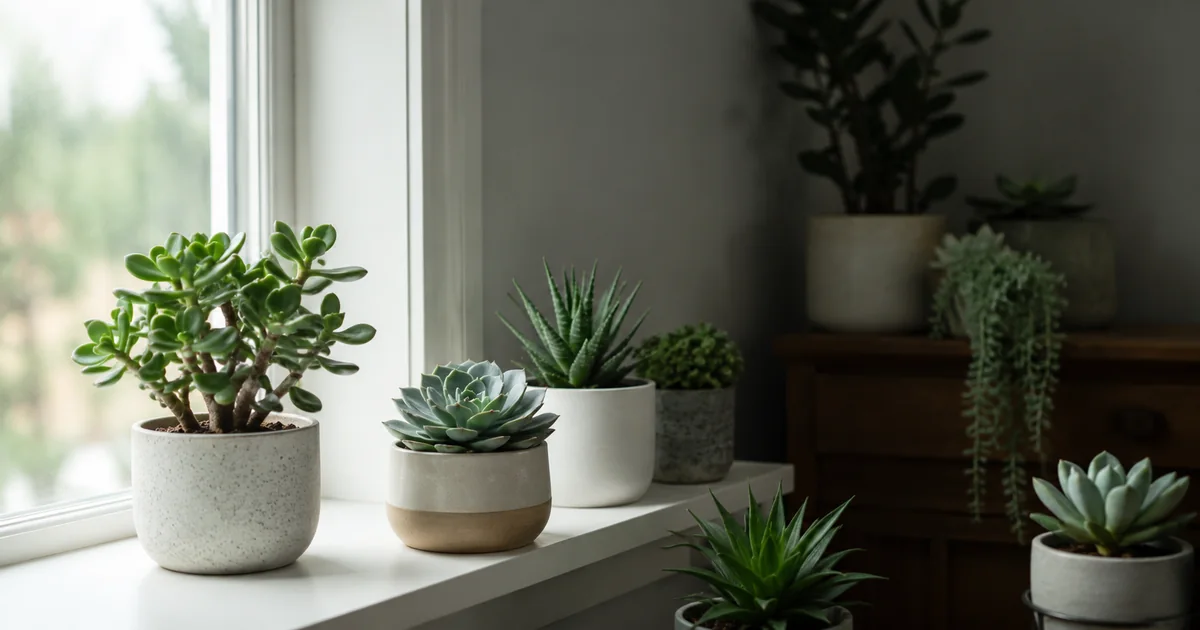
Most succulents are not low-light plants. “Succulent” describes plants that store water in leaves, stems, or roots; it does not describe one light requirement. Many common cacti and compact rosette succulents need strong light to keep their normal shape, while some woodland or naturally shaded succulents tolerate gentler light. Species identity matters more than the label “succulent.”
Why Succulent Light Needs Differ
Succulents evolved in habitats ranging from exposed deserts to the shade beneath shrubs and forest canopies. The Royal Horticultural Society recommends bright light for most indoor cacti and succulents, but identifies rainforest succulents—including holiday cacti, *Epiphyllum*, and *Rhipsalis*—as exceptions that prefer semi-shade and protection from hot sun.
Haworthias offer another useful example. Wisconsin Horticulture explains that many grow naturally in shade from rocks or shrubs. They tolerate indoor conditions better than many sun-loving rosettes, but insufficient light still causes elongated leaves and weaker color. “Lower-light tolerant” therefore does not mean “healthy in darkness.”
Before choosing a position, identify the plant as closely as possible. A care label that says only “assorted succulent” is not enough to determine whether it belongs on a bright sill or behind filtered light.
Survival Versus Compact, Healthy Growth
A succulent may use stored resources and look unchanged for weeks in a dim room. That is survival, not proof that the position supports new growth. Evaluate the newest growth over time:
- compact leaves and short, species-typical spacing suggest the light may be adequate;
- widening gaps between leaves or a lengthening stem can indicate etiolation;
- leaning shows the plant is orienting toward stronger light, but occasional rotation does not solve an inadequate light level;
- fading or changing color can involve light, but also temperature, water, nutrition, natural aging, or cultivar traits.
Etiolation is growth produced under inadequate light. Once a stem has stretched, it will not shrink back when conditions improve. Better light can help future growth become more compact, while severe distortion may eventually require pruning and propagation appropriate to the species.
A Low-Light Succulent Decision Tool
| Condition | What you may observe | What it suggests | What to do next |
|---|---|---|---|
| Compact, symmetrical new growth | Normal spacing and form | Current light may be adequate for that species | Keep observing through seasonal changes |
| Stem lengthening or leaves spreading farther apart | Stretching toward a source | Possible insufficient light | Verify species needs and move gradually brighter or add a plant light |
| Plant leans strongly toward a window | Uneven growth direction | Light is stronger on one side; total light may also be low | Measure or compare positions; rotate only after improving inadequate light |
| Loss of red, purple, or dark coloration | Greener or paler growth | Could reflect lower light, but genetics and temperature also affect color | Judge structure and vigor too; do not chase stress color at the expense of plant health |
| Soft or translucent leaves | Tissue feels weak or water-soaked | Often a moisture or root problem rather than simple light shortage | Stop and inspect roots, drainage, and recent watering |
| Potting mix stays wet for a long time | Little change in pot weight or moisture | Low light may be slowing water use; drainage or mix may also be poor | Delay watering, improve the root environment, and reassess light |
| Bleached, tan, or scorched patches after a move | Damage appears on exposed surfaces | Sunburn from an abrupt increase is possible | Move out of harsh exposure and acclimate more gradually |
No single symptom proves a diagnosis. Look at the plant’s newest growth, root condition, moisture, and recent environmental changes together.
Window Direction and Seasonal Change
Window direction is only a starting point. A south-facing window in the Northern Hemisphere is often bright, while the equivalent sun-facing aspect reverses in the Southern Hemisphere. Trees, buildings, roof overhangs, curtains, latitude, and glass all alter exposure.
The light at one window also changes with season. A place that supports compact growth in summer may be too dim in winter, while a plant close to cool glass may face temperature stress. Observe the hours and intensity of light reaching the leaves rather than relying on a room label.
Our guide to what low light means for plants covers simple measurements such as lux and foot-candles. Use a meter at canopy height to compare positions, but consult species guidance instead of treating one number as a universal threshold for all succulents.
Lower-Light Tolerance Is Relative
Useful, supported examples include:
- Haworthias: Often more accommodating of filtered indoor light than exposed-desert succulents, yet they elongate and lose strong coloration when light is insufficient.
- Rainforest cacti such as *Schlumbergera*, *Epiphyllum*, and *Rhipsalis*: Adapted to more sheltered conditions and generally protected from hot, direct exposure.
- Many common compact rosette succulents and cacti: Usually need a brighter position to retain dense form. Do not assume a decorative shelf far from a window is adequate.
Snake plants are also succulent in the broad water-storage sense and tolerate low indoor light, but they have different growth and care from small desert rosettes. Use species-specific guidance, such as our Snake Plant care guide, rather than transferring its tolerance to every succulent.
Why Low Light Raises Overwatering Risk
In lower light, growth and water use commonly slow. If you keep watering on the same timetable, the root zone may remain wet for longer. Succulent roots still need oxygen; stored water does not protect them from persistently saturated, poorly aerated mix.
Check moisture through the pot, not only the dry-looking surface. Confirm that the container drains freely, empty any outer cachepot, and use a suitable porous mix. Then water based on actual drying and the species’ growth stage. Our houseplant watering guide explains why a fixed weekly schedule is unreliable.
Using a Grow Light Without Guessing
A grow light can support succulents where window light is inadequate, but there is no universal “correct” distance or 12-hour rule. A small lamp and a high-output fixture can deliver very different light at the same distance.
Use a practical setup process:
- Check the fixture manufacturer’s coverage and distance guidance.
- Measure or compare light at the top of the plant, not at the bulb or desk.
- Use a timer so the daily light period is consistent and the plant still has darkness.
- Watch for compact new growth, heat, bleaching, or continued stretching.
- Adjust height or duration gradually rather than making large changes at once.
PPFD is the most plant-relevant measurement commonly published for grow lights, but beginners do not need to calculate a perfect target without species-specific data. Fixture guidance plus the plant’s new growth is more useful than wattage alone.
Acclimate Succulents to Stronger Light
Do not move a plant from a dim indoor shelf directly into intense midday sun. Wisconsin Horticulture specifically warns that a Haworthia kept without much direct sun can burn if moved abruptly outdoors. Increase exposure over days or weeks, beginning with gentler morning light or bright shade, and account for heat as well as brightness.
The same principle applies after shipping, winter, or a long spell behind curtains. Acclimation prevents avoidable damage; it does not mean a naturally shade-adapted species should ultimately receive desert-level sun.
The Bottom Line
Ask “Which succulent is this, and is its new growth normal here?” rather than “Can succulents live in low light?” Some can tolerate filtered conditions; many common types need substantially brighter light for healthy, compact growth. Pair the species’ requirements with measured observation, slower watering in dim conditions, and gradual acclimation when exposure changes.
Sources
- Royal Horticultural Society: How to Grow Cacti and Succulents — general bright-light needs and rainforest-succulent exceptions.
- Royal Horticultural Society: Cacti and Succulent Houseplants — why most common indoor succulents are unsuitable for poor light.
- Wisconsin Horticulture: Haworthias—Super Succulents for Small Spaces — shade adaptation, etiolation, artificial light, and gradual sun acclimation.
- University of Minnesota Extension: Lighting for Indoor Plants and Starting Seeds — light measurements, grow-light concepts, and reduced water use in lower light.
- Royal Horticultural Society: Artificial Lighting for Indoor Plants — selecting and using artificial light indoors.
Related Plant Guides
 INDOOR PLANTS
 INDOOR PLANTS
 INDOOR PLANTS