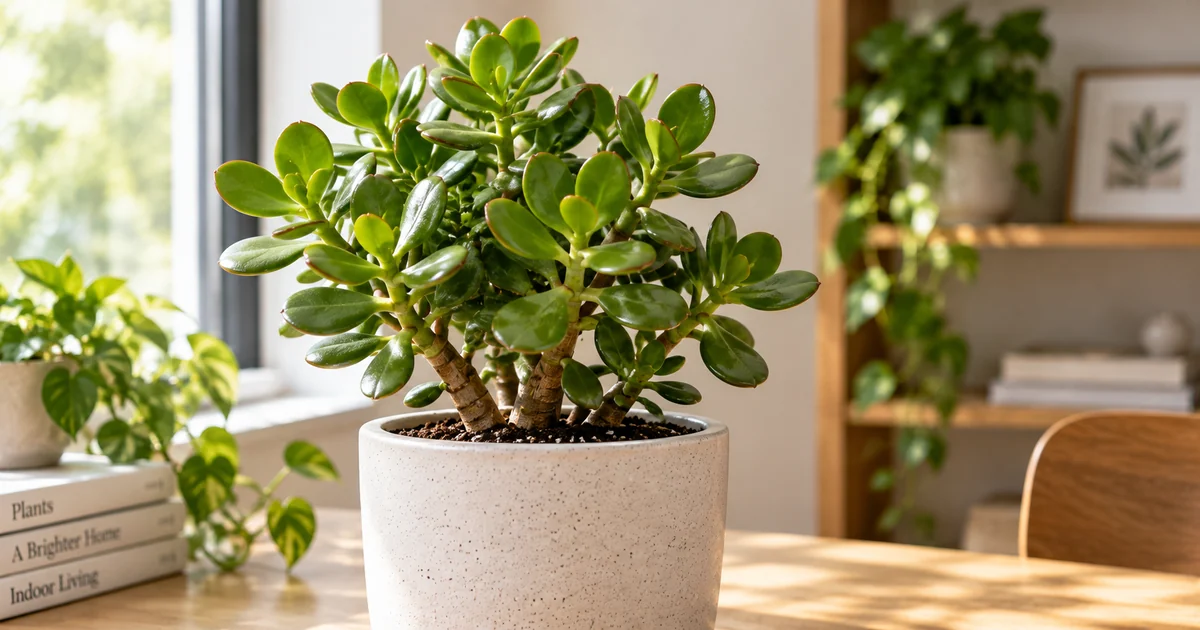
Jade plant (Crassula ovata) is a succulent shrub, not simply a generic foliage houseplant that happens to need less water. Its leaves, young stems, and roots store water; its stems become woody as it matures; and strong light helps it develop compact branching. Care should preserve that structure: bright light introduced gradually, a fast-draining root zone, thorough but well-spaced watering, and pruning that directs growth rather than merely shortening the plant.
Let Succulent Structure Guide Watering
Jade leaves are useful clues because they store water, but they do not replace a root-zone check. Water thoroughly when the potting mix has dried substantially, then let excess leave through the drainage hole. Do not leave the container standing in water.
Before watering again, check more than the surface. Lift the pot, test the medium at depth, and consider how long the lower root zone has remained damp. A heavy pot with soft leaves needs a different response from a light pot with slightly wrinkled, flexible leaves.
Avoid fixed intervals such as “every two weeks.” A small jade in strong summer light can dry much faster than a large plant in a cool winter room. Root density, container material, mix, humidity, and active growth all change water use.
Wrinkling can follow extended dryness, but it can also occur when damaged roots cannot deliver water. Soft or translucent leaves may be associated with excess moisture or cold injury. Use the plant’s history and root-zone condition before deciding.
Light Builds a Compact Jade Plant
Jade plants need brighter conditions than many tropical foliage plants. Several hours of direct sun or very bright light can support short internodes, sturdy stems, and dense growth. In insufficient light, stems lengthen between leaf pairs, lean, and remain less able to support the heavy foliage.
Do not move a shade-grown plant directly into intense midday sun. Acclimate it by increasing exposure in stages over at least several days, starting with gentler morning or late-day sun. Sunburn can create pale, tan, or brown patches that do not turn green again.
Red margins can be a normal response to strong light in some plants and cultivars. Red color alone does not prove sunburn, drought, or nutrient deficiency. Compare it with tissue texture, recent exposure, and whether patches are sharply damaged or merely pigmented.
Rotate the pot periodically for balanced growth, but avoid constantly changing location while the plant adjusts.
Use a Pot and Mix That Protect the Roots
A jade plant needs a high-porosity, fast-draining medium. A commercial cactus or succulent mix is a starting point, not a guarantee; it should wet evenly, drain freely, and retain air as it dries. If it remains dense for long periods, add a stable coarse component suitable for container culture.
The pot must have a drainage hole. Jade plants become top-heavy, so a broad, stable clay or ceramic container can reduce tipping, but material alone does not prevent persistent wetness. Match watering to how quickly that pot and mix dry.
Repot when the medium has collapsed, roots or drainage no longer function normally, or the plant is unstable—not merely because roots touch the pot wall. Jade plants can remain in a snug container for years. Increase only one practical pot size to avoid creating a large wet zone around a small root mass.
Shape Branches and Develop a Stronger Trunk
Jade produces opposite pairs of leaves and branches from nodes below a cut. Pruning just above a healthy node can redirect growth and encourage branching, creating a denser canopy and a trunk better able to support it.
Prune during active growth when the plant has enough light to respond. Use clean, sharp tools and remove one structural problem at a time: crossing stems, an overly long weak shoot, damaged tissue, or top-heavy growth. Do not remove so much foliage that a light-stressed plant loses most of its photosynthetic surface.
Green young stems naturally become brown and woody as they age. A firm, evenly maturing stem is different from black, soft, or collapsing tissue. Do not diagnose rot from bark color alone.
Seasonal Growth and Temperature
Jade growth often slows with shorter days and lower indoor light. During slower growth, the root zone usually takes longer to dry, so watering and feeding should be reduced according to conditions rather than stopped on a date.
Protect jade from freezing temperatures, cold windows, and abrupt cold exposure. Chilling or frost injury may appear as soft, dark, translucent, or collapsing tissue, sometimes after the temperature event. If moving a plant outdoors for warm weather, acclimate it to stronger light and bring it inside before frost.
Average indoor humidity is generally suitable. Misting does not improve the root environment and can leave moisture on dense foliage; it is not a routine jade-care requirement.
Feed for Measured Growth, Not Speed
Fertilize only during active growth when roots are healthy. Check whether fresh potting mix already contains fertilizer, then use a product labeled for succulents or houseplants at its directed rate. Heavy feeding can contribute to salt accumulation and soft, weak growth; it cannot correct etiolation caused by insufficient light.
If growth is slow, assess season, light, root condition, potting mix, and pests before assuming the plant lacks nutrients. A naturally slow-growing, compact jade does not need to be pushed into rapid growth.
Jade Plant Symptom Decoder
The appearance of one leaf rarely proves a cause. Use the first-check column to separate water, light, cold, root, and normal growth responses.
| What you see | Check first | Possibilities to compare | Next step |
|---|---|---|---|
| Soft or translucent leaves | Root-zone moisture and recent cold exposure | Persistent wetness, root stress, chilling or freeze injury | Stop automatic watering; inspect roots or damaged tissue if decline continues |
| Wrinkled, flexible leaves | Pot weight, moisture at depth, and roots | Extended dryness, root damage, heat stress | Water only if the root zone is genuinely dry; otherwise investigate roots |
| Leaf drop | Which leaves, moisture history, temperature, and recent moves | Normal lower-leaf aging, drought, persistent wetness, cold, abrupt environmental change | Stabilize conditions and monitor the pattern on new growth |
| Long spaces and leaning stems | Light intensity and direction | Etiolation from insufficient light | Increase light gradually; prune only after better light supports compact regrowth |
| Red leaf margins | Recent light increase and tissue condition | Normal high-light pigmentation, cultivar trait, or stress | Leave healthy firm tissue; reduce exposure only if true scorch develops |
| Blackened or mushy tissue | Temperature history, base firmness, roots, and drainage | Cold injury, prolonged wetness, root or stem deterioration, physical injury | Remove the plant from the damaging condition and assess living tissue promptly |
| Slow growth | Season, usable light, roots, and fertilizer history | Normal pace, winter slowdown, low light, root restriction or damage, pests | Correct the strongest supported limitation rather than feeding automatically |
Yellowing, softness, and leaf drop are not enough to label a plant “overwatered.” Overwatering describes repeated watering behavior; persistent wetness is the root-zone condition. Root rot requires evidence of deteriorating tissue, such as roots or stem bases that are mushy, collapsing, sloughing, or easily breaking alongside decline.
Propagate Without Keeping Cuttings Wet
Jade can be propagated from stem or whole-leaf cuttings. Stem cuttings usually produce a shaped young plant sooner; leaf cuttings take longer to form roots and a new shoot.
For a stem cutting:
- Cut a healthy section just below a node with a clean tool.
- Remove leaves that would sit against the medium.
- Let the cut surface dry and callus for a few days in a shaded, airy place.
- Insert it into a small container of dry to barely moist, fast-draining medium.
- Keep it in bright filtered light and avoid repeated watering while it has few roots.
For a leaf cutting, remove an intact leaf at its base, allow it to callus, and rest the base on well-drained medium. A leaf may form roots before it produces a new shoot, so visible roots alone do not mean a complete new plant has developed.
Do not put an unrooted succulent cutting on the same watering routine as an established jade. With little or no root system, it uses water slowly and is vulnerable to decay in constantly moist mix.
Pests and Pet Safety
Mealybugs are a common jade pest and can hide at nodes and in tight new growth. Scale and spider mites may also occur. Isolate a confirmed infestation, identify the pest, and use a control labeled for the plant and setting. Test sprays cautiously because succulent foliage can be sensitive to some products.
The ASPCA lists jade plant as toxic to cats and dogs. Reported signs include vomiting, depression or lethargy, and incoordination. Keep the plant away from pets that chew foliage. If ingestion is suspected or an animal shows signs, contact a veterinarian or animal poison-control service; do not attempt a home remedy.
A Jade-Specific Care Routine
Use four observations instead of a calendar: leaf firmness, pot weight, moisture at depth, and the compactness of new growth. Firm leaves and short, sturdy shoots suggest that water and light are reasonably balanced. When the plant changes, compare the timing with watering, cold, relocation, repotting, or a light increase before making several corrections at once.
Sources
- University of Wisconsin–Madison Extension — Jade Plant, Crassula ovata
- North Carolina Extension Gardener Plant Toolbox — Crassula ovata
- University of Connecticut Home Garden Education Center — Jade Plants
- University of Maine Cooperative Extension — Creating New Plants from Old Plants
- ASPCA — Jade Plant Toxicity